Home Blog Page 223

MX Gold Corp. – Vertical Integration Pathway

3

Kal Kotecha PhD

Vertical integration is one of the most crucial strategies companies in the junior mining space can implement. With large CAPEX and OPEX inherent in the mining industry, achieving vertical integration can be imperative to develop highly specified minerals and adapt to the unique conditions that individual mines exhibit while reducing risk and maintaining stable production costs. Some of the most common advantages gained through vertical integration include increased control over value-added functions, the ability to invest and develop greatly specialized assets, and increase production flexibility (Strategy Train, 2009). In the fluctuating market that defines the junior mining sector, these advantages – particularly those related – to control are critical to a company’s long term success.

One company that has embodied the vertical integration strategy is MX Gold Corp. (TSX-V: MXL) (“MX” or “the Company”). MX Gold Corp. is a junior mining company focused on the mining, exploration and development of advanced projects located in the Kootenay region of British Columbia. The Company’s primary focus is its high-grade Willa gold and copper project located 12 kilometres south of Silverton, B.C. Having recently rebranded from Discovery Ventures Inc. to the current name of MX Gold Corp., the Company has experienced exciting new progressions which have correlated with a stock price increase. Junior Gold Report has extensively written about MX Gold Corp. under its previous name, and the reintroduction of MX Gold Corp. as a rising stock warrants further discussions about the competitive advantages the Company’s business model fosters along with the new developments that we believe will serve to benefit its current and future shareholders.

MX Gold Corp. is currently valued at around $0.20, have experienced rapid growth in the past month, moving from a price of $0.125 on May 16th to its current price. This share price increase coincided with a corporate announcement detailing the increase of the Company’s size of its private placement financing. On June 6th, the Company announced that it had increased the number of Units it would issue at a price of $0.12 per Unit to 33,333,333 units from the previously announced 25,000,000 units. Gross proceeds of $4,000,000 are projected to be earned from the release. Funds raised will be used toward advancing its flagship WillaMAX Project and for general working capital.

As discussed in previous articles, the four most important drivers of value for this company are:

  • High AU-CU grades based on measured, indicated and inferred resources
  • 100%-owned nearby mill – modern turnkey facility acquired for a minimal capital expenditure
  • Strong business leadership and financial strength
  • Near-term cash flow potential from a permitted 10,000 tonne bulk sample


Flagship Project – WillaMAX Project

The Company’s primary focus is its high grade Willa Gold, Copper and Silver project located 12 kilometres south of Silverton, B.C. In 2015, MX Gold completed the accretive acquisition (100% ownership) of the Willa project and the Max Molybedum Mine and Mill Complex, a fully permitted 1000 tonne per day mill and tailings facility. The two separate components of the project – the mine and the mill complex – combine to produce a strong vertical integration that has resulted in positive movement in the stock’s price each time an advancement has been made in the past two years.


Willa Mine

The Willa Gold, Copper and Silver mine contains high-grade resources as outlined below and has been explored since the 1890’s when the area was dubbed the “Silvery Slocan.” The property houses major gold and copper resources along with identified silver resources and has been extensively explored and researched, which has contributed to well measured resource estimates. Between 1980 and 2005 the property was owned by various companies including BP Minerals, Rio Algom and others who collectively invested approximately $18M to explore and develop the property. As you can imagine, this means solid access to the location and many of the property’s “kinks” already worked out.

The most recent data on the resources within the property came in 2012 through the NI 43-101 report which provided the following outcomes:

Category Tonnes Au (g/mt) Cu (%) Ag (g/mt)
Measured 198,000 5.36 0.83 8.30
Indicated 627,000 4.97 0.86 9.50
Measured + Indicated 825,000 5.07 0.85 9.20
Inferred 151,000 4.21 0.71 9.80

Source: MX Gold Corp. – Corporate Slide Deck

The resource is amenable to open pit mining with increasing grades at depth that have been measured at greater than 15g / t Au. These features collectively define a property with excellent exploration and development potential.

kal checks out the rocks

In March, the Company announced plans to activate the Willa Gold, Copper, Silver deposit for 2016. MX received a permit to mine a 10,000 tonne bulk sample and is in the process of working with the requisite ministries to apply for a small mines permit. Recently, the Company announced that following the completion of the construction of a road and an engineering study, truck runway lanes and upgrading erosion and sediment control structures will be completed.

In this same announcement, the Company highlighted further plans for property development and provided a timeline of 4-5 months to commence full underground operations on the property. The Company states that phase 2 of its plan, expansion and development, is now 90% complete. Phase 3 will occur between August and December of 2016 and includes the installation of other surface facilities along with preparation and commissioning of equipment and facilities.

Considering the stock’s price was driven up 100% from the mere announcement of increased units available for purchase, shareholders should be salivating for an announcement that development and production of the resource site will begin. We can reasonably assume that this point will occur sometime in late 2016 or early 2017, at which time we project a major stock price increase for MX Gold Corp.

MAX Molybdenum Mine and Mill Complex

The most significant development MX Gold Corp. has made in recent years is the purchase of the MAX Molybdenum Mine and Mill Complex, located approximately 135km away from the Willa mine. This facility is nearly brand new and is regarded as a first rate production centre and was purchased for just $6 Million. This is wildly impressive considering the fact that, up to 2012, in an effort to build a molybdenum operation that unfortunately failed because of the collapse in moly prices, Roca Mines & Forty Two Metals invested over $100 million building the MAX mine and mill. Further, the Company’s investment came with a $50 million tax pool, which will serve as a major benefit to MX in the coming years of its operation. The mine and facility are so pristine that they won the 2009 B.C. Mining & Sustainability Award. Engineers for the Company have stated that the process of treating the mineralized gold-copper-silver material from the Willa mine, as opposed to the originally intended molybdenum, is a relatively simple technical transition for this mill and will require minimal capital expenditure. The CAPEX for the project is very low, at a rate of just $12.8 Million.

The acquisition of the mine, and more importantly the mill complex, is a brilliant move by the Company, and references back to my statement at the beginning of this article; MX Gold Corp. is embodying the critical vertical integration strategy that increases the likelihood of making junior mining companies successful. Once the Willa mine is prepared for development, the Company will have complete and controlled access to a state of the art production facility with low CAPEX and OPEX because of the nature of its acquisition. Moving forward on the value chain, the Company will be able to integrate its core business areas and flexibly determine a production schedule for its mined resources, acting on bullish mineral markets while easing during times of stagnant growth.
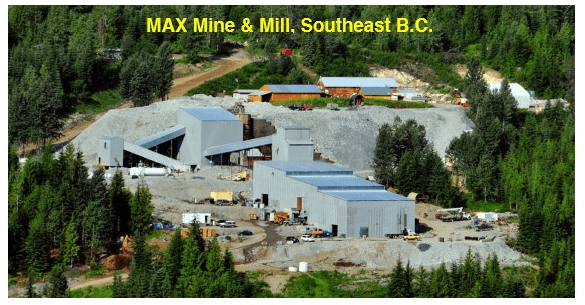
Max Mine and Mill

Described by Resource Wire contributor Jay Currie as as “creative thinking” the vertical integration strategy is something that more junior mining companies should explore. As noted by Currie, “moving a resource towards profitable production involves more than simply drilling out the site and reporting the results. The reality is that the resources have to be mined and processed” (Currie, 2014). MX Gold Corp.’s vertical integration strategy encompasses these two crucial consideration, but the scope of the strategy does not simply end there.

The Company’s Chairman and CEO, Dan Omeniuk, is the president of Trappers Transport, a North American leader in providing temperature controlled transportation services. Dan’s company recently agreed to a $7 Million credit facility to advance to the WillaMax Project. With Mr. Omeniuk’s involvement, MX now has access to at-cost transportation expertise to move its raw materials from the Willa Mine to the MAX Mill Complex for processing and onward to finishing stages or end users. Holding the supply, processing and distribution components of the Company’s key business functions, MX Gold Corp. is positioned to leverage its assets strategically to execute the production and distribution of its resources with great precision.
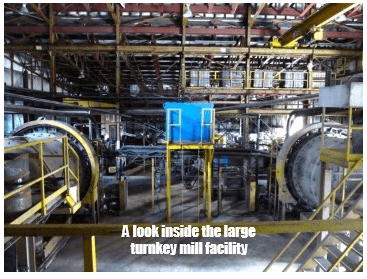
inside-facility

Conclusion

The economics of the WillaMAX Project are encouraging, and showcase an outstanding IRR and NPV projection, as detailed below:

PEA Base Case Highlights – 500 tpd Operation – 4.25-year Mine Life

Total revenue: $164 million

CAPEX: $12.8 million

OPEX: $82.8 million

NPV (10% discount): $55 million

IRR (pre-tax): $412%

Metal price assumptions ($USD): $1,200 Au / $3.00 Cu / $3.00 Cu

Though the stock’s price has risen greatly in recent weeks, the projections above still suggest that the MX Gold Corp.’s stock (TSX-V: MXL) remains undervalued, especially for investors with the capacity to purchase the stock and carry it for an annual term. When viewing MX’s stock performance over the past year, the overall trend is beginning to turn for the Company and over the next few months, the stock’s price can be expected to return to the region it was at in September 2015 with upcoming development and phase progression announcements. Looking further, when mine and mill production begin in late 2016 or early 2017, expect the stock’s price to leap even higher, returning to levels seen one year ago and possibly higher.
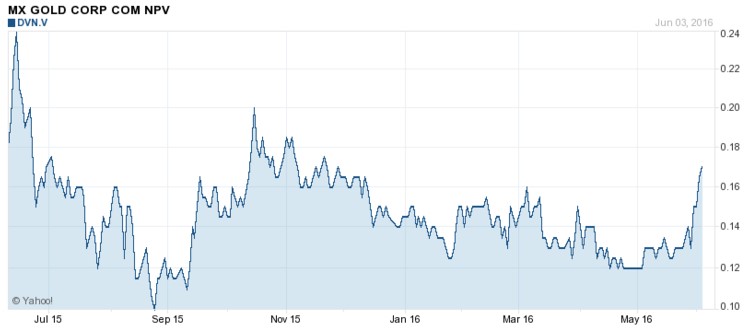
mx-gold-com

Source: MX Gold Corp. website

Share Structure

Shares Outstanding: 95,124,718

Options: 21,366,200

Warrants: 10,378,600

Fully Diluted Shares: 126,869,518


Source: MX Gold Corp. website

MX Gold Corp.’s vertical integration strategy will see the Company through the coming months and move it to a point of highly controlled and flexible extraction, production and distribution of its resources. The integration of these crucial components will result in success for the Company and ultimately, success for its investors.


Works Cited

Currie, Jay. “Creative Thinking at Discovery Ventures.” Creative Thinking at Discovery Ventures. Resource Wire, 27 Feb. 2015. Web. 11 June 2016

MX Gold Corp. N.p., n.d. Web. 11 June 2 2016 <http://mxgoldcorp.com/>

“Why Choose Vertical Integration? Benefits and Drawbacks.” Strategy Train. Lifelong Learning Programme, 2009. Web. 11 June 2016

Happy Investing!

Disclaimer

© 2010 Junior Gold Report

Junior Gold Report’ Newsletter: Junior Gold Report’s Newsletter is published as a copyright publication of Junior Gold Report (JGR).  No Guarantee as to Content:  Although JGR attempts to research thoroughly and present information based on sources we believe to be reliable, there are no guarantees as to the accuracy or completeness of the information contained herein. Any statements expressed are subject to change without notice. JGR, its associates, authors, and affiliates are not responsible for errors or omissions. Consideration for Services: JGR, it’s editor, affiliates, associates, partners, family members, or contractors may have an interest or position in featured, written-up companies, as well as sponsored companies which compensate JGR. JGR has been paid by the company written up. Thus, multiple conflicts of interests exist. Therefore, information provided herewithin should not be construed as a financial analysis but rather as an advertisement. The author’s views and opinions regarding the companies featured in reports are his own views and are based on information that he has researched independently and has received, which the author assumes to be reliable. No Offer to Sell Securities: JGR is not a registered investment advisor. JGR is intended for informational, educational and research purposes only. It is not to be considered as investment advice. Subscribers are encouraged to conduct their own research and due diligence, and consult with their own independent financial and tax advisors with respect to any investment opportunity. No statement or expression of any opinions contained in this report constitutes an offer to buy or sell the shares of the companies mentioned herein. Links: JGR may contain links to related websites for stock quotes, charts, etc. JGR is not responsible for the content of or the privacy practices of these sites. Release of Liability: By reading JGR, you agree to hold Junior Gold Report its associates, sponsors, affiliates, and partners harmless and to completely release them from any and all liabilities due to any and all losses, damages, or injuries (financial or otherwise) that may be incurred.

Forward Looking Statements 

Except for statements of historical fact, certain information contained herein constitutes forward-looking statements. Forward looking statements are usually identified by our use of certain terminology, including “will”, “believes”, “may”, “expects”, “should”, “seeks”, “anticipates”, “has potential to”, or “intends’ or by discussions of strategy, forward looking numbers or intentions. Such forward-looking statements involve known and unknown risks, uncertainties and other factors which may cause our actual results or achievements to be materially different from any future results or achievements expressed or implied by such forward-looking statements. Forward-looking statements are statements that are not historical facts, and include but are not limited to, estimates and their underlying assumptions; statements regarding plans, objectives and expectations with respect to the effectiveness of the Company’s business model; future operations, products and services; the impact of regulatory initiatives on the Company’s operations; the size of and opportunities related to the market for the Company’s products; general industry and macroeconomic growth rates; expectations related to possible joint and/or strategic ventures and statements regarding future performance. Junior Gold Report does not take responsibility for accuracy of forward looking statements and advises the reader to perform own due diligence on forward looking numbers or statements.

MGX Minerals Completes Bulk Sample at Driftwood Creek Magnesium

VANCOUVER, BRITISH COLUMBIA – June 9, 2016 – MGX Minerals Inc. (“MGX” or the “Company”) (CSE: XMG /FKT:1MG) is pleased to announce that field crews and operators have completed the previously announced 100-tonne bulk sample (see press release dated May 16, 2016) at the Company’s flagship Driftwood Creek magnesium project (“Driftwood”).On the morning of June 8, 24 vertical holes with alternating depth of 30 and 40 feet were loaded to 7 feet from the drill hole collars with AMEX explosives. The charges were set at the approximate center of the East Zone at Driftwood. Detonation was by time delay fuse and occurred at 11:45pm (MST) resulting in a successful and complete blast.

“We are excited to have entered the bulk sample phase at Driftwood Creek,” stated MGX President and CEO Mr. Jared Lazerson. “The potential to prove up the certainty component of the upcoming maiden National Instrument (N.I.) 43-101 resource estimate is significant. As well, many of the mine operating costs, such as the amount of explosives required on a per tonne basis, are now being defined.”

Mucking and loading of material has commenced in preparation for assay, advanced metallurgy, and kiln testing. Kiln testing will produce representative multi-tonne samples for distribution to prospective customers in Canada, the United States and Europe.

Since acquiring the project in July 2014, MGX has completed two diamond drill programs, property wide sampling and re-analysis of historic drill core. Magnesite mineralization has been traced over a strike length of 2,000 meters and up to 300 meters wide, reaching a true depth of 110 meters. The deposit remains open in both directions and at depth. Mineralization occurs in two discrete zones that are believed to have been enriched during a period of metamorphic recrystallization. MGX was issued a 20-year Mining Lease by the Ministry of Energy and Mines of the Province of British Columbia in January 2016 (see press release dated January 11, 2016).

MGX acquired Driftwood in 2014 and subsequently completed eight diamond drill holes on the East zone. Drill results included 49 meters of 43.04% magnesium oxide (MgO) in drill hole 2014-2 and 47.6 meters of 41.43% MgO in drill hole 2014-5 (see press release dated December 11, 2014). In 2015 the Company re-assayed historic drill core from previous Optionee Tusk Exploration. Results included 130 meters of 42.46% MgO in drill hole 2008-2 (see press release dated May 7, 2015). MGX also conducted a phase two drill program over the Western Zone in 2015. Drill highlights included 64 meters of 40.71% MgO in drill hole 2015-3 and 98 meters of 44.28% MgO in drill hole 2015-4 (see press release dated October 5, 2015).

Historic exploration at Driftwood dates back to the 1970’s when Kaiser Resources conducted exploration and mined an 8,000 metric tonne test quarry in 1978 (Morris, 1978). In 1987 Canadian Occidental acquired Driftwood and drilled four NQ-sized diamond drill holes and as well as collecting 68 core samples weighing five kilograms each.

Figure 1. Driftwood East Zone Blast Preparation
Driftwood East Zone Blast Preparation

Figure 2. Driftwood East Zone Bulk Sample Pit
Driftwood East Zone Bulk Sample Pit

Driftwood Creek Magnesium
MGX Minerals has the right to acquire a 100% interest in the Driftwood Creek magnesium project. The Company has completed a Phase I and Phase II drill program at Driftwood Creek and has now conducting a 100-tonne bulk sample program. MGX received a 20-year Mining Lease for Driftwood Creek in January (see press release dated January 11, 2016).

Qualified Person
This press release was prepared under the supervision and review of Andris Kikauka, P. Geo. and Vice President of Exploration for MGX Minerals. Mr. Kikauka is a non-independent Qualified Person within the meaning of National Instrument (N.I.) 43-101 Standards.About MGX Minerals
MGX Minerals (CSE: XMG) is a diversified Canadian mining company engaged in the acquisition and development of industrial mineral deposits in western Canada that offer near-term production potential, minimal barriers to entry and low initial capital expenditures. The Company operates lithium, magnesium and silicon projects throughout British Columbia and Alberta, including the Driftwood magnesium project. MGX has recently received approval of a 20 year mining lease for Driftwood and bulk sampling is currently underway.For more information please visit the Company’s website at www.mgxminerals.com.

Contact Information
Jared Lazerson
Chief Executive Officer
Telephone: 604.681.7735
Email: jared@mgxminerals.com

Neither the Canadian Securities Exchange nor its Regulation Services Provider (as that term is defined in the policies of the Canadian Securities Exchange) accepts responsibility for the adequacy or accuracy of this release.

Forward-Looking Statements
This press release contains forward-looking information or forward-looking statements (collectively “forward-looking information”) within the meaning of applicable securities laws. Forward-looking information is typically identified by words such as: “believe”, “expect”, “anticipate”, “intend”, “estimate”, “postulate” and similar expressions, or are those, which, by their nature, refer to future events. The Company cautions investors that any forward-looking information provided by the Company is not a guarantee of future results or performance, and that actual results may differ materially from those in forward-looking information as a result of various factors. The reader is referred to the Company’s public filings for a more complete discussion of such risk factors and their potential effects which may be accessed through the Company’s profile on SEDAR atwww.sedar.com.

Oil or Gold — Where to Invest?

0

Kal Kotecha PhD

Is Saudi Arabia still the King of the world oil supply? The market forces have changed so that the world’s dominant producer is no longer the big kid on the block. Even though they boast the lowest cost of production, I argue that the floor will be set by the American shale producers. It depends how much they will produce as they have a higher production cost. The cost varies but the all in cost includes the capital costs spread out over time. To continue to make marginal revenue, they must continue to produce at lower prices since the initial capital outlay is so large. In conjunction, the management of these shale companies (and management in general) can only get paid if there is production, even at a total break even cost, therefore as the colloquial statement reads, “the show must go on!” At the current price of about $50/barrel, many shale producers can at least break-even.

The European Central Bank is striving to avert a deflationary spiral in the region and announced a program to buy 1.1 trillion ($1.2 trillion US) of bonds. This may be a great sign for gold and silver in general. Any type of stimulus package generally bodes well for a price increase in the metals but I argue that inflation caused stimulus doesn’t necessarily increase the price of precious metals. Take for example QE, QE2 and QE3 in the U.S., the increase prices of the metals based on inflation (which has not taken place except in real estate) didn’t really occur. In turn, a deflationary environment as the economy is currently in is generally not bad for gold either — many ‘analysts’ reckon that a deflationary environment is ‘bad’ for precious metals and inflation is ‘good.’ When in actual fact deflation hasn’t been “really” negative for precious metals the past 2-3 years, especially when you take the price of gold in Japanese Yen and in Canadian Dollar terms.

What does the result of the higher US$ against the CDN$ mean for investors? It is excellent for Canadian companies that produce gold in the US — they just essentially received a 20% increase to their bottom line. These are the sorts of companies I am investing in expecting a huge payout as the price of gold starts to rise.

On an economic note, even though the CDN$ is low comparatively, meaning that the standard of living is being lowered for Canadians due to rising import costs, the manufacturing sector seems to be elated. The problem lies in the fact that most of the manufacturing jobs in Canada that left for cheaper producing countries are no longer present. Does that mean that GM and Chrysler are going to make their way back to St. Catharine’s and Windsor just because the dollar fell — I highly doubt it! And with many white collar jobs leaving i.e. Tim Horton’s, Target, and MEXX, the Canadian economy seems to be in a tail spin. Canada West isn’t elated due to low oil prices and lack of demand for base metals and I believe Canada East is still in a recession. The lower dollar should help the Eastern Canadian economy but I do not think as much as is being let on. The monetary policy issue is whether the Bank of Canada should raise rates or lower them. By lowering rates, you encourage borrowing and spending but continue to have a lower valued dollar. By increasing rates, our dollar rises which makes imports cheaper and helps to alleviate the pressure of the dollars free fall mainly caused by lower oil prices. But I do not believe the Minister of Finance should be increasing rates despite the hot housing market. By increasing rates, the tax payer would be paying more to pay off the interest on the Canadian debt.

In summary, deflation is not necessarily ‘negative’ for the prices of precious metals. Lowering interest rates in Canada to even negative interest rates might be the most prudent step to continue churning the Canadian economy. As to whether to invest in Oil or Gold—I choose the latter.

Happy Investing!

Kal Kotecha PhD

Don’t Bank On Rate Hikes!

0

This past Friday, June 3rd, 2016, The Bureau of Labor Statistics released their most recent report regarding new employment data and nonfarm payroll employment which indicates that during May of 2016, it was the smallest increase seen in 28 months.

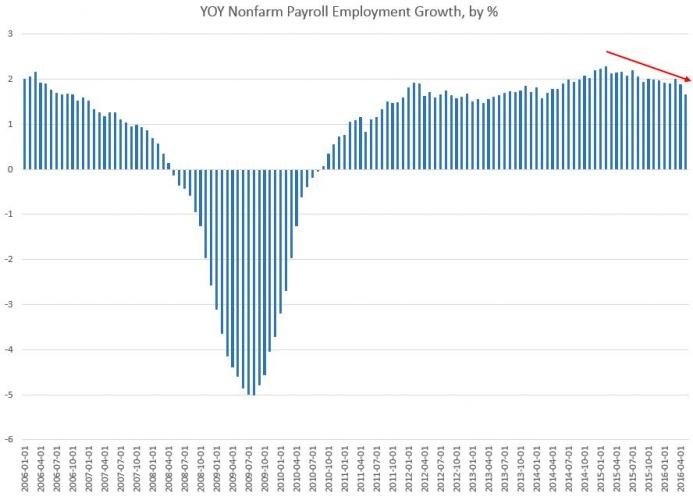
During May of 2016, there were 144,592,000 payroll jobs within the US, which was up by 1.6 percent, or equivalent to 2.3 million jobs, from May of 2015 (These are all not-seasonally-adjusted numbers).

That represents the smallest year-over-year increase that has been reported since February of 2014, at which time payroll jobs increased by 1.57 percent. The largest year-over-year increase, in recent years, was reported during July of 2015, when it was up by 2.18 percent:

jobs1

Since July of 2015, the general trend in growth has been down. This 1.6 percent remains well below where growth was during most of the 1990’s.

I am not fond of using the seasonally adjusted numbers, since they add an additional layer of ‘needless manipulation’. I do prefer to compare job growth, from the same time of year, over several years.

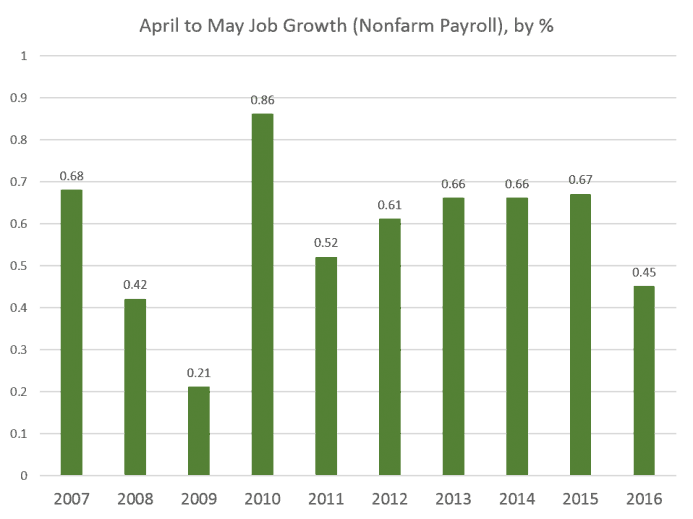
When I do this, I find that the job growth from April to May of 2016, was the lowest April-May growth total since 2009:

jobs2

From April to May of 2016, there were 651,000 new jobs added, which is a significant drop from that same period of time, last year when 947,000 jobs had been added. Over the past decade, this current year of 2016, in this measure, beats out only 2008 and 2009, both of which were years of ‘economic decline’. Therefore, May of 2016 was the weakest May on record, for job growth, in eight years.

The Secretary of Labor, Tom Perez attempted to blame everything on the Verizon strike. That is a nice “spin”, however, the strike does not explain the obvious ‘decline’ in the year-over-year numbers! The strike might explain why the May numbers dropped off as much as they did, however, it cannot explain the ‘trend’. It is a bit of a stretch to blame this drop from April-May of 2015 to April-May of 2016 on the Verizon strike.

Mr. Perez, however, attempted some other, even less convincing, claims as well, stating that the U.S.’s insufficient mandates on paid family leave means that fewer women are entering the work force, and therefore pushing down the jobs totals. Is this IMPORTANT? The answer is NO! These bad numbers merely reflect our current poor economic situation, today!
In any case, the overall trend should not be a big surprise, as it has always has been weak. It has been dependent on the FED and their low interest rates. In recent quarters, the FED has finally been backed into a corner and has become hawkish. Realizing that more rate cuts are unlikely to occur any time soon, the economy is not receiving the usual FED-manufactured stimulus which investors and companies have both become accustomed to. With the FED talking about the need to raise ‘rates’, who can be surprised that the “recovery” is nonexistent?

The financial news, of the past few weeks, had its cadre of regional FED Presidents attempting to sway markets into believing that the Central Bank was sure to ‘hike’ interest rates during this current month of June 2016.

The jobs report sent ‘shock waves’ throughout the entire financial system. The report printed a jobs number of just 38,000 new employees, which is the lowest single month since the height of the “Great Recession”.

What is even more ludicrous than this, is the fact that the unemployment rate fell to 4.7 percent seeing as 664,000 workers are no longer being counted and included, by the government, within the labor force.

The FED relies heavily on these ‘manipulated’ government jobs numbers, the idea of “data dependency” being used to determine when to ‘hike’ or ‘drop’ interest rates shows the incompetency of a body that supposedly employs hundreds of economists who are dedicated to discover the true state of the economy and of its’ economic data. This in turn, should provide Americans with the reality that not only does the Central Bank have any idea what they are doing, but, more often than not their policy decisions are based on ‘incorrect’ and ‘outdated’ models which have only served to make matters worse, since the “Credit Crisis of 2008”.

The majority of jobs created were either part-time or low-wage service sector oriented. You can bank on the fact that the FED is now more likely to lower ‘rates’ than they are to raise them, going forward!

Today, it is both unlikely and irrational for the FED to raise interest rates either now or in the near future, despite the Central Banks’ recent “moral suasion” on mass media, of a potential rate ‘hike’ occurring as early as this month or possibly next month. The FED continues to create policies in an attempt to protect the economy and stock markets through November of 2016 so as to “spin” the election in favor of Hillary Clinton. This is due to the uncertainty from the presumptive Republican candidate, Donald Trump, who may force the Central Bank into ending its’ mission to fuel ‘stock and housing bubbles’. I, myself, as well as many economists, are seeing the ‘Summer of 2016’ as a dangerous period of time where and when a financial, economic, or monetary ‘collapse’ could take place from any number of ‘flashpoints’. The actions that are now taking place, in the equity markets, are an indication that these ‘fears’ may very well be arriving much sooner than most analysts expect.

The economy is still performing ‘significantly’ below its’ potential:

The problem is that the FED, including other Central Banks, have waited too long and gone too far in their ‘zero interest rate’ policies and ‘quantitative easing’ programs. With all of this nonsensical talk coming from the FED, the debt default levels, especially for credit default swaps on the 10-year Treasury are NOW at their highest level since the FED raised rates by a quarter of a point, back in December of 2015.

The probability of a U.S. default of its’ debt has hit its’ highest point since the FED has hiked rates in December of 2015. This is indicated by the recent dynamics in credit-default swap (CDS) agreements. The expectations that the Central Bank may raise borrowing costs still further, in the coming months, will set off this ‘time bomb’. Since the FED has turned increasingly hawkish of their policy outlook since late April 2016, market volatility has increased, with stocks swinging between gains and losses and U.S. Treasuries sliding along slide with the dollar. “Systemic risks” stemming from the CDS transactions are rising amidst the unfavorable global financial environment. This is not only true in the U.S., but its’ counterparts are also subject to greater turmoil in the coming months, as possible FED hikes, “Brexit” concerns, U.S. elections and faltering global growth are all interconnected factors thereby contributing to the recent spikes in U.S. CDS spreads.

If things follow the FED script, I imagine that next months’ payrolls will exceed ‘tapered down’ expectations and consequently, there will be an upward revision of Mays’ numbers. Will this continue sending the market into exuberance? NO! However, the FED officials will then restart the rate ‘hike’ talks with just enough offsetting uncertainties to mislead everyone while trying to keep the market ‘bubble’ from ‘bursting’.

The financial system is like a giant game of poker with all the major player holding a seven and two off suite (worst hand you can have), yet they are all-in with their chips (money & policies) trying to bluff their way out of this mess.
Things are going to be very crazy over the next 6-12 months and beyond, but until the US large cap stocks breakdown and start a bear market expect tough trading and investing.

Find out what I think the market is doing and where its headed with my ETF Trade Alerts: www.TheGoldAndOilGuy.com
Chris Vermeulen

MGX Minerals Acquires Rights to Rapid Lithium Brine Production Process

VANCOUVER, BRITISH COLUMBIA – June 6, 2016 – MGX Minerals Inc. (“MGX” or the “Company”) (CSE: XMG / FKT:1MG) is pleased to report the Company has acquired intellectual property and design rights (the “Rights”) to a proprietary processing design that proposes to reduce lithium brine evaporation times by >99% over standard solar evaporation pond processes, from approximately 18 months to 1 day.
The design was developed as part of the previously announced Design and Scoping Study. All intellectual property rights have now been acquired from the inventor. The Company has retained Fasken Martineau, an international business law firm, to conduct an intellectual property assessment and prepare documentation for the filing of a patent.

MGX currently controls a land package of approximately 300,000 hectares (1,150 square miles) of lithium brine bearing properties in Alberta. This includes 14 of the 24 highest grade (>=90mg/L) lithium assays throughout the Province as reported by the Alberta Geological Service. The production process was designed specifically for the highly mineralized brine associated with MGX’S lithium properties.

“This proprietary design process, combined with vast existing infrastructure in Alberta, positons MGX at the forefront of the rapidly developing lithium brine industry,” stated MGX President and CEO Jared Lazerson. “The potential advantage of using a new design to reduce lithium brine processing time is significant. Solar evaporation is necessary due to a deficiency of infrastructure that existing lithium brine producers face, particularly in the remote high altitude deserts of South America where options are extremely limited. As well, the cost/revenue model has shifted dramatically due to surging demand for lithium compounds, creating an opportunity to change how lithium is produced moving forward. There are a number of areas for improvement including the elimination of solar evaporation. We believe the Company has solved the issue of very long production times, relatively low recoveries (40-50%) currently associated with lithium brine processing, and real estate requirement of lake size solar evaporation ponds. We are now moving to protect this intellectual property as it may have great value to MGX and the lithium industry moving forward.”

About MGX Minerals
MGX Minerals (CSE: XMG) is a diversified Canadian mining company engaged in the acquisition and development of industrial mineral deposits in western Canada that offer near-term production potential, minimal barriers to entry and low initial capital expenditures. The Company operates lithium, magnesium and silicon projects throughout British Columbia and Alberta, including the Driftwood magnesium project. MGX has recently received approval of a 20 year mining lease for Driftwood and bulk sampling is currently underway.

For more information please visit the Company’s website at www.mgxminerals.com.

Contact Information
Jared Lazerson
Chief Executive Officer
Telephone: 604.681.7735
Email: jared@mgxminerals.com

Neither the Canadian Securities Exchange nor its Regulation Services Provider (as that term is defined in the policies of the Canadian Securities Exchange) accepts responsibility for the adequacy or accuracy of this release.

Forward-Looking Statements
This press release contains forward-looking information or forward-looking statements (collectively “forward-looking information”) within the meaning of applicable securities laws. Forward-looking information is typically identified by words such as: “believe”, “expect”, “anticipate”, “intend”, “estimate”, “postulate” and similar expressions, or are those, which, by their nature, refer to future events. The Company cautions investors that any forward-looking information provided by the Company is not a guarantee of future results or performance, and that actual results may differ materially from those in forward-looking information as a result of various factors. The reader is referred to the Company’s public filings for a more complete discussion of such risk factors and their potential effects which may be accessed through the Company’s profile on SEDAR at www.sedar.com.

Stock Market Elliott Wave Count, Economic Cycle and Equities Cycle

0

Stock Market Elliott Wave Count, Economic Cycle and Equities Cycle

As you know a picture is worth 1000 words so consider this short yet detailed post a juicy 2000+ word report on the current state of the stock market and economic cycle.

The charts below I think will help you see where the US stock market and economic cycles appear to be.

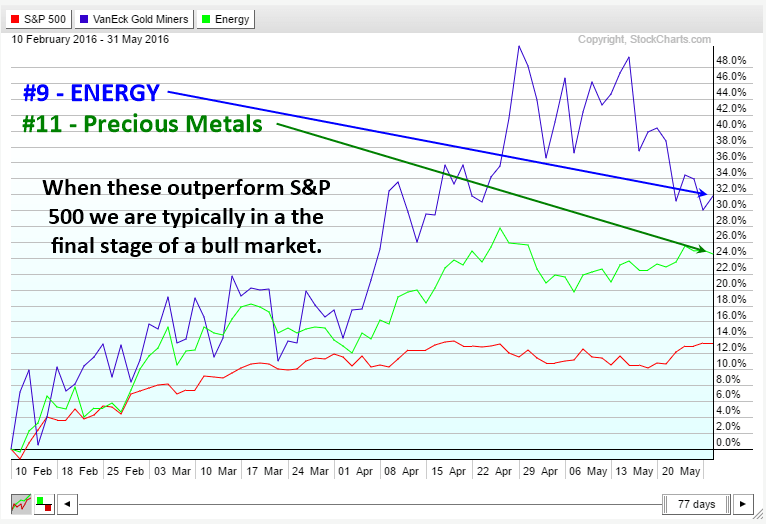
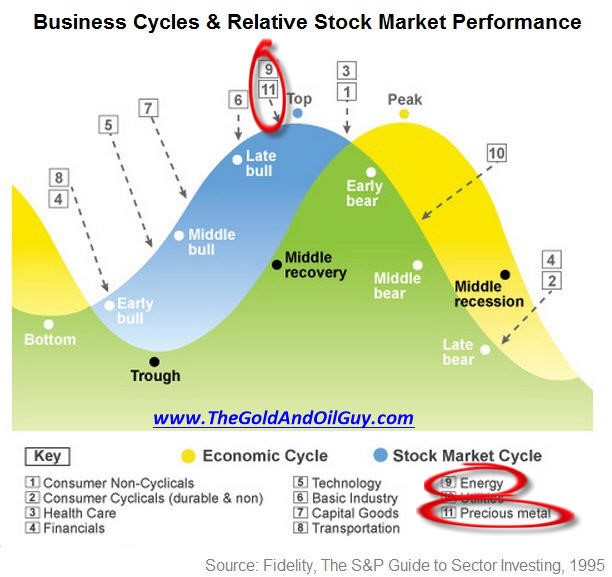
The first image shows two cycles, the blue one is the stock market cycle and which sectors typically outperform during specific times within the cycle. Here you will see that during the late stages of a bull market the safe haven plays become the preferred choice for investors – Energy and Precious Metals.

Typically, the stock market tops before the economic (business) cycle does. Why? Because investors can see sales starting to slow and that earnings will start to weaken and share prices will fall, so the market participants start selling shares before the masses see and hear about a weakening economy. The stock market usually moves 3-9 months before the economic cycle change I known by the masses.

oilandgold

Stock Market Topping According to Sector Analysis

elliet wave]

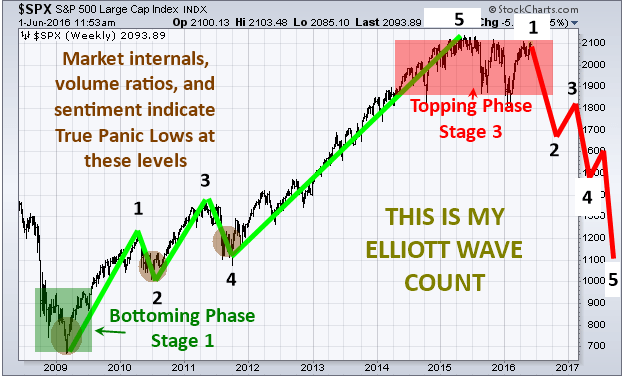
Elliott Wave Count – My Educated Guess

Elliott wave theory is a tough strategy to follow. Meaning, if you gave the same chart to 5 different people you would likely have 3 or 5 very different wave counts.

Recently I have seen a flurry of EW charts on the SP500 wave count which I do not think are correct. When I do Elliott Wave counts I like to use more than just price. I look into things deeper and use the market internals, volume flows, and overall market sentiment during those times. They must all be screaming extreme FEAR in the market in order for me to count it as a wave low.

Fear is much easier to read and time than greed. So based on waves of fear and I can plot the rest of the waves. By doing this, I feel it gives a truer reading of significant highs and lows we should use in our analysis.

See my analysis below for a visual…

ellietwavecount

Stock Market & Economic Cycle Conclusion:

In short, the current market analysis, in my opinion, is still very bearish and this could actually be the ultimate last opportunity to get short the market near the highs before we dive into a full blown bear market in the next 3-5 months.

I will admit, the market is trying VERY hard to convince us it wants to go higher as it flirts with the recent highs for its second time in the past 8 months. I know it is doing its job because so many traders and investors are changing their tune from bearish to SUPER BULLISH.

I don’t see it that way JUST yet, but it could happen as the market can do and will do whatever it wants. But all my analysis (much more than what you see here) points to substantially lower prices over the next year.

To learn more and get my ETF swing trades and long term investing signals join me at www.TheGoldAndOilGuy.com

Chris Vermeulen