Home Blog Page 202

Look to Chindia for Gold’s Love Trade

0

Full Article : Look to Chindia for Gold’s Love Trade

By Frank Holmes

A few weeks ago, I shared with you what I brought home from my trip to Toronto, Vancouver and New York City, where I had met with gold fund analysts. The current gold bull run began in January, but as I told you, the general retail investors weren’t buying then. The only people buying that early were quants and huge hedge funds. The question, then, was: What factors or models were the quants using to uncover gold’s meteoric rise this year?

One of the factors they were looking at, I learned, was low SG&A-to-revenue. “SG&A” stands for “selling, general and administrative expenses” and refers to the daily operational costs of running a company that are not related to making a product. It includes everything from shipping fees to salaries to utilities. SG&A-to-revenue is an unusual factor, not typically used among analysts and fund managers, so we were curious to apply it.

Using this information, we looked just at the first quarter to find the mining companies that spent the least amount of money on these daily operations relative to revenue. Mining companies, after all, have had trouble with expense discipline.

What we discovered was nothing short of astonishing. All combined, the top 10 gold companies for the quarter—led by South Africa-based Harmony Gold—returned a spectacular 88 percent. That’s almost double what the Market Vectors Gold Miners ETF (GDX) returned over the same period (45.5 percent).

image: http://www.stockhouse.com/getattachment/7516ffde-cdec-4496-a52f-704f4a35d65f/frank_913_2.png

frank_913_2.png

As early as January, the drivers were in place to fuel gold’s best first half of the year since 1974. The yellow metal is now in position to have its best year overall since 2010, when it rose 29.5 percent.

DISCOVER INVESTMENT OPPORTUNITIES IN THE GOLD SPACE

Upcoming Festivals Could Activate Love Trade

I talk a lot about the differences between gold’s Fear Trade and Love Trade. Loyal readers know that the Fear Trade is associated with negative real interest rates and excessive money supply, which triggers an imbalance of monetary and fiscal policies and macroeconomic uncertainty. Historically, investors in the U.S., Japan, Germany and the U.K. have been the main drivers of the global Fear Trade.

The Love Trade, on the other hand, is all about gold’s powerful allure and its timeless role as a gift without peer. It has two significant benefits: one, as beautiful gold jewelry to be worn, and two, as financial security. Although gold jewelry is often given as a special gift in Western countries, it pales in comparison to what takes place in China and India, or “Chindia”—home to about 40 percent of the world’s population, and the two largest gold importers.

The following image, courtesy of Visual Capitalist, shows emphatically just how enormous this region’s population is. More people live inside the green circle—which covers not just India and China but also Japan and some South China Sea countries—than outside it.

image: http://www.stockhouse.com/getattachment/226b493f-5189-45a1-8170-1492c643351b/frank_913_3.png

frank_913_3.png

As I shared with you last month, the two Asian countries together accounted for more than half of total global gold jewelry demand in 2015. The U.S., by comparison, represented about 5 percent of demand. All of Europe, even less.

Significant to boosting the metal’s price are important cultural events, from India’s upcoming Diwali festival and fourth-quarter wedding season to the Chinese New Year in January. Going back decades, the yellow metal has tended to perform best in September, when jewelry, coin and bullion dealers restock their inventories in preparation for these celebrations.

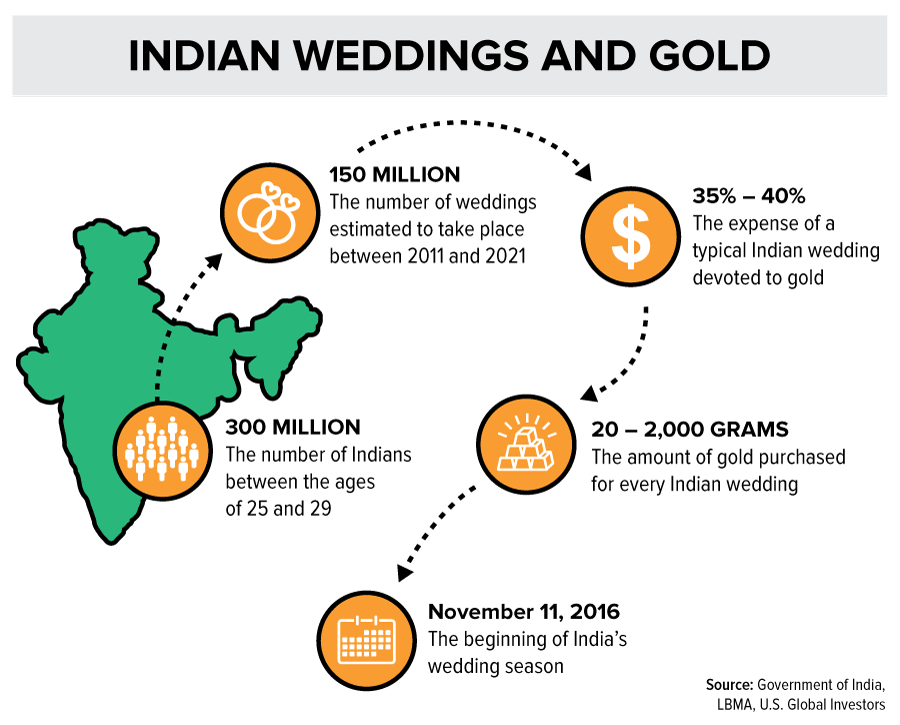
Also known as the Festival of Lights, Diwali begins October 30 this year, followed by the wedding season. To give you a sense of scale, as many as 150 million Indian weddings will be held between 2011 and 2021, according to the Government of India. For each wedding, between 0.7 and 70 ounces of gold are typically purchased, which is equivalent to 35 percent to 40 percent of total wedding expenses.

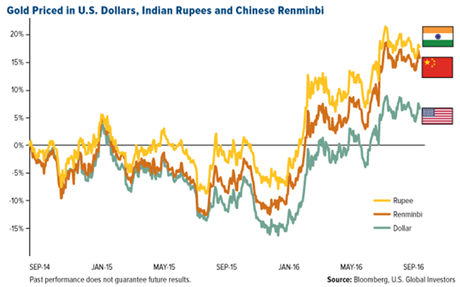
Of course, you can’t convert cash into gold if you don’t have the cash. What’s more, gold priced in Indian rupees and Chinese renminbi has really taken off, making it more expensive to Indian and Chinese consumers than America buyers.

image: http://www.stockhouse.com/getattachment/4fc95b06-58c4-4843-8506-e04f4376fb96/frank_913_4.png
frank_913_4.png

Gold consumption, then, really depends on household income. Fortunately, income growth in Chindia is booming with the rise of the middle class.

Rising Incomes = Golden Opportunity

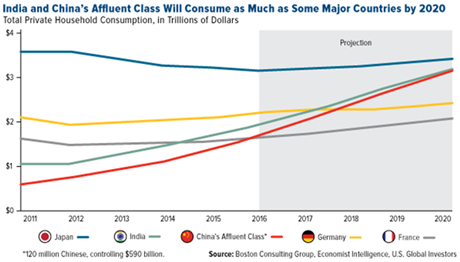
And just how much income growth are we talking about? According to Boston Consulting Group (BCG) data, consumer spending in both China and India will soon overtake spending in Germany and France, and is on a trajectory to match Japan’s level of consumption.

image: http://www.stockhouse.com/getattachment/9053c77a-bf01-4437-9dcc-494bc045d640/frank_913_5.png
frank_913_5.png

By 2020, the number of “affluent” households in China—those with annual incomes of at least $20,000—will grow to 280 million, equal to 30 percent of the country’s urban population. That’s quite a leap up from today’s 120 million households labeled as “affluent.” It’s also good news for the Love Trade.

As for India, the number of middle class consumers is expected to triple between now and 2025, eventually reaching 89 million people, according to McKinsey & Company.

What I find even more incredible is that by 2030, the economic output of India’s top five cities is expected to reach the size of five middle-income countries today, according to McKinsey. Mumbai’s massive $245 billion economy, for example, could soon exceed the entire country of Malaysia. Likewise, India’s capital city of New Delhi could one day be bigger than the Philippines.

This presents a huge opportunity for the Love Trade to expand even more, as rising incomes and economic momentum have been a tailwind for gold demand.

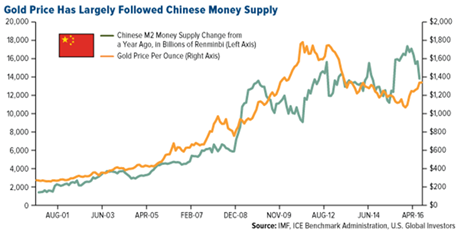
I’ve pointed out before the relationship between M2 money supply growth in China and the price of gold. Money supply isn’t the same as income growth, of course. But it serves as further evidence that the more money that’s available—and the more people who have access to that money—the more it can be converted into gold.

image: http://www.stockhouse.com/getattachment/259a665a-183e-4678-ade8-a7565663808e/frank_913_6.png
frank_913_6.png

Negative real interest rates play an important role as well, as I’ve discussed many times before. The yellow metal shares an inverse relationship with real rates, which is what you get when you subtract inflation from nominal interest rates.

image: http://www.stockhouse.com/getattachment/98f3cd07-af1f-4be8-bf7c-23eb103a5488/frank_913_7.png

frank_913_7.png

Speaking of which, many investors are wondering if rates will rise this year or not. December is still on the table, but the likelihood of a hike this month seems to have been doused by the August jobs report, which came in below expectations. CNBC reports that Goldman Sachs economists walked back their call for a September rate hike when it was revealed the U.S. economy added only 151,000 jobs, 32 percent fewer than the same month a year ago and a whopping 69 percent decrease from July’s payroll additions.

Be that as it may, markets seem to be betting the end of easy money could arrive sooner rather than later. Stocks sold off today in their worst session since June 24, the day after Brexit.

Last Friday, both gold and silver jumped on the underwhelming jobs numbers. As I told Daniela Cambone during last week’s Gold Game Film, which you can watch here, silver is an important metal to follow because as people develop more confidence in the precious metal area, silver could begin to take center stage.

India Now the Fastest Growing Large Economy

In June, I asked if India is the new China. I think the jury’s still out on that question, but what we do know is that India has pulled ahead of China to become the world’s fastest growing large economy. In its June update to its world economic outlook, the International Monetary Fund (IMF) sees India advancing 7.4 percent this year, compared to China’s 6.6 percent. On a relative basis, these are much stronger growth rates than what we find in advanced economies such as the U.S., European Union and Japan.

image: http://www.stockhouse.com/getattachment/db93ba2e-6bad-4bd3-b087-b74a9e78848b/frank_913_8.png

frank_913_8.png

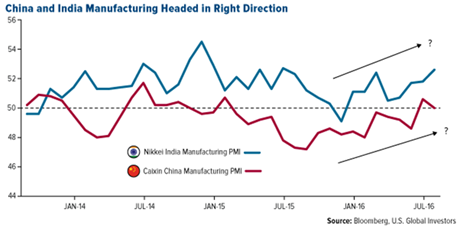
India’s manufacturing sector appears to be growing at a faster clip than China’s, when we compare the two Asian giants’ purchasing manager’s indices (PMI). For the month of August, the India PMI rose to 52.6 from 51.8 in July, indicating healthy sector expansion.

image: http://www.stockhouse.com/getattachment/889497d6-14f8-4283-becb-b8b000db983d/frank_913_9.png
frank_913_9.png

Meanwhile, China logged a neutral 50, indicating neither expansion nor contraction. But as you can see above, the trend is headed in the right direction and making steady improvements from its recent low of 47.2 in September 2015.

For the one-year period, the First Trust ISE Chindia Index Fund (FNI) is up more than 23 percent, as of September 4, suggesting the bad news we’ve been seeing in the media might be over, and the markets in China and India may have reached a bottom. This is good for global growth and the Love Trade.

Book Your Flights!

At the end of this month, I will be a speaker and panelist at Mines and Money in Toronto. The conference, one of the biggest and most attended in the world, brings together leading institutional investors, mining developers and sought-after industry experts. It will take place September 26 through 28, so don’t hesitate to book your flights. I hope to see you there!

All opinions expressed and data provided are subject to change without notice. Some of these opinions may not be appropriate to every investor. By clicking the link(s) above, you will be directed to a third-party website(s). U.S. Global Investors does not endorse all information supplied by this/these website(s) and is not responsible for its/their content.

The Caixin China Manufacturing PMI, released by Markit Economics, is based on data compiled from monthly replies to questionnaires sent to purchasing executives in over 400 private manufacturing sector companies.

The Nikkei India Manufacturing Purchasing Managers’ Index, reported by Markit Economics, measures the performance of the manufacturing sector and is derived from a survey of 500 manufacturing companies.

M2 Money Supply is a broad measure of money supply that includes M1 in addition to all time-related deposits, savings deposits, and non-institutional money-market funds.

Holdings may change daily. Holdings are reported as of the most recent quarter-end. The following securities mentioned in the article were held by one or more accounts managed by U.S. Global Investors as of 6/30/2016: Sibanye Gold Ltd., Northern Star Resources Ltd., Regis Resources Ltd.

U.S. Global Investors, Inc. is an investment adviser registered with the Securities and Exchange Commission (“SEC”). This does not mean that we are sponsored, recommended, or approved by the SEC, or that our abilities or qualifications in any respect have been passed upon by the SEC or any officer of the SEC.

This commentary should not be considered a solicitation or offering of any investment product.

Certain materials in this commentary may contain dated information. The information provided was current at the time of publication.
Read more at http://www.stockhouse.com/opinion/independent-reports/2016/09/13/look-to-chindia-for-gold-s-love-trade#ytwqBJ3BZfM34z0L.99

Full Article : Look to Chindia for Gold’s Love Trade

By Frank Holmes

Disclaimer© 2010 Junior Gold ReportJunior Gold Report’ Newsletter: Junior Gold Report’s Newsletter is published as a copyright publication of Junior Gold Report (JGR). No Guarantee as to Content: Although JGR attempts to research thoroughly and present information based on sources we believe to be reliable, there are no guarantees as to the accuracy or completeness of the information contained herein. Any statements expressed are subject to change without notice. JGR, its associates, authors, and affiliates are not responsible for errors or omissions. Consideration for Services: JGR, it’s editor, affiliates, associates, partners, family members, or contractors may have an interest or position in featured, written-up companies, as well as sponsored companies which compensate JGR. JGR has been paid by the company written up. Thus, multiple conflicts of interests exist. Therefore, information provided herewithin should not be construed as a financial analysis but rather as an advertisement. The author’s views and opinions regarding the companies featured in reports are his own views and are based on information that he has researched independently and has received, which the author assumes to be reliable. No Offer to Sell Securities: JGR is not a registered investment advisor. JGR is intended for informational, educational and research purposes only. It is not to be considered as investment advice. Subscribers are encouraged to conduct their own research and due diligence, and consult with their own independent financial and tax advisors with respect to any investment opportunity. No statement or expression of any opinions contained in this report constitutes an offer to buy or sell the shares of the companies mentioned herein. Links: JGR may contain links to related websites for stock quotes, charts, etc. JGR is not responsible for the content of or the privacy practices of these sites. Release of Liability: By reading JGR, you agree to hold Junior Gold Report its associates, sponsors, affiliates, and partners harmless and to completely release them from any and all liabilities due to any and all losses, damages, or injuries (financial or otherwise) that may be incurred.

Forward Looking Statements
Except for statements of historical fact, certain information contained herein constitutes forward-looking statements. Forward looking statements are usually identified by our use of certain terminology, including “will”, “believes”, “may”, “expects”, “should”, “seeks”, “anticipates”, “has potential to”, or “intends’ or by discussions of strategy, forward looking numbers or intentions. Such forward-looking statements involve known and unknown risks, uncertainties and other factors which may cause our actual results or achievements to be materially different from any future results or achievements expressed or implied by such forward-looking statements. Forward-looking statements are statements that are not historical facts, and include but are not limited to, estimates and their underlying assumptions; statements regarding plans, objectives and expectations with respect to the effectiveness of the Company’s business model; future operations, products and services; the impact of regulatory initiatives on the Company’s operations; the size of and opportunities related to the market for the Company’s products; general industry and macroeconomic growth rates; expectations related to possible joint and/or strategic ventures and statements regarding future performance. Junior Gold Report does not take responsibility for accuracy of forward looking statements and advises the reader to perform own due diligence on forward looking numbers or statements.
Gold and Gold Stocks Correction Continues

0

Gold and Gold Stocks Correction Continues

Jordan Roy-Byrne CMT, MFTA    https://thedailygold.com/gold-and-gold-stocks-correction-continues/

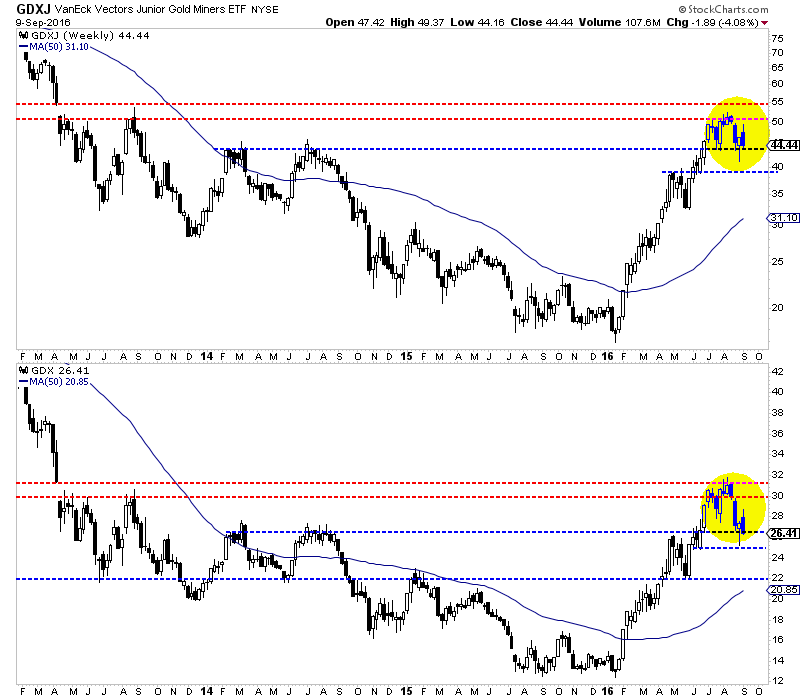
The failure of Gold and gold stocks to sustain recent gains coupled with a strong selloff to close the week dashes any hope that the correction ended last week. The charts and probabilities argue that the sector remains in a larger correction and perhaps has started the C portion of a typical A-B-C (down-up-down) correction.

This week started out strong for the miners but that strength faded and was completely reversed with Friday’s selloff. GDX and GDXJ closed down 3%-4% for the week and left nasty bearish candles on the weekly charts. GDXJ, which made a low of $41 last week could test at least $39 while GDX, which tested a low of $25 last week has downside potential to $22.


sep92016minersw


Before I get to Gold, here is an important note on GDX. During bull market corrections, GDM, the parent index of GDX often found support at its 400-day exponential moving average. This happened seven times during 2002-2003, 2006 and 2009-2010. The 400-day exponential moving average for GDX is currently at $22 and rising slowly. Hence, I consider $22-$23 as a potential bottom for GDX.

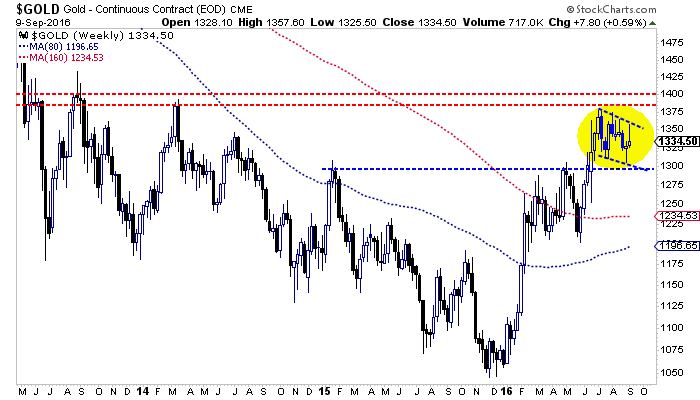
Turning to Gold, we note that Gold failed at the $1355-$1360 resistance earlier in the week. That coupled with Friday’s decline increases the odds that Gold will head lower to the bottom of its channel near $1300. Gold closed at $1334. It has support at $1300-$1310 and $1275-$1280.


sep92016goldw


The negative reversal in miners and metals at the end of this week (and their failure to hold the rebound) signals that a larger and longer correction is playing out and more downside potential is directly ahead. GDX closed at $26.41. It has a very strong confluence of support around $22 which includes its 200-day moving average, its 400-day exponential moving average (noted above) and the 50% retracement of the entire rebound. Do not be surprised if this target is reached quickly, such as in days and not weeks. Remember that fishing line type declines (think of the trajectory of a fishing line) are a buying opportunity.For professional guidance in riding the uptrend in Gold, consider learning more about our premium service including our favorite junior miners which we expect to outperform in the second half of 2016.


Jordan Roy-Byrne, CMT, MFTA      https://thedailygold.com/gold-and-gold-stocks-correction-continues/

Jordan@TheDailyGold.com

A New FOMC Policy Statement Everyday

0

A New FOMC Policy Statement Everyday

Andrew Hoffman   http://www.silverseek.com/commentary/new-fomc-policy-statement-everyday-15935

It’s early Tuesday, and I’m going to do something rare – and petty – in the name of making a point.  Which is, to refer yet again – anonymously, of course – to the reader a few weeks back, who hounded me with emails, asking why I don’t “back up” my “call” for lower oil prices with more “proof.”

The reason this annoyed me was manyfold – starting with the fact that neither I, nor Miles Franklin, have “called” anything.  Nor are we required to, given that our service is entirely free of charge, with no pretense other than to tell the truth as we see it.  Which hopefully, will inspire you to protect yourself from the political, economic, and financial hell unfolding as we speak – which will NOT STOP until every fiat currency is dramatically devalued, if not destroyed.  Yes, we’d like you to purchase and/or store your metals with Miles Franklin – which we believe, offers the best combination of prices, service, and ingenuity in what is generally speaking, a highly homogenous bullion industry.  But we’d be just as happy if we helped you understand the world better, and give us a reference – or heck, a mere shout out – when warranted.

Back to oil, I cannot emphasize enough that aside from being a Chartered Financial Analyst, or CFA, for the past 18 years, I spent 10 years working as an oilfield service, equipment, and drilling analyst – including six at Salomon Smith Barney, where my team was ranked by Institutional Investor magazine as one of the top research groups in our sector for four straight years.  Moreover, the top-ranked analyst covering the major oil producers, for as long as I worked there, sat right next to us.  His primary job, aside from covering Exxon Mobil, BP, and other large producers, was generating the firm’s oil price forecast – which, I might add, consistently understated reality, as he apparently “forgot” to incorporate that little old thing called monetary inflation.  That said, I have a very deep background in the fundamentals behind oil supply and demand – plus, the history and efficacy of OPEC – although I certainly don’t claim to be an “expert” in all facets.

In other words, when I make claims about oil, I know something of what I talk about, albeit not everything.  And in that context, everything I’ve seen and read tells me the supply/demand outlook is worse than, as I put it last week, “any time since oil was first used commercially.”  Which sadly, goes not just for oil, but essentially all commodities, per the “manifesto” I wrote nearly two years ago, based on the fantastic work of David Stockman, titled “the direst prediction of all.”  In which, I discussed how three-plus decades of unfettered money printing and financial engineering have caused historic gluts in essentially every commodity – other than gold and silver, which have experienced the polar opposite effect, due to the simultaneous suppression of those decidedly non-commoditized commodities.  Non-commodities, because unlike all other substances that fit such description, gold and silver have been universally used as money throughout history.

Moreover, I also know a thing or two about market manipulation, given that I’ve spent the past 14 years exhaustively analyzing every tick of the stock, bond, commodity, and Precious Metal markets.  And trust me, despite the fact that oil sits all the way down at $45/bbl, it has been “goosed” higher by every imaginable manipulative tactic since bottoming (temporarily) at $26/bbl earlier this year.  The so-called “oil PPT” has attempted everything from OPEC rumors; to relentless propaganda; to even, as we saw last week, cooking inventory numbers to desperately prevent the continued collapse of the world’s most important financial market.  To wit, commodities generate more revenues; jobs; and subsequently, social stability than any “business” on the planet.  And now that they are free falling, it’s no wonder economies are crashing, currencies imploding, Central banks hyperinflating, and political regimes tumbling.  And sadly, they will continue to do so for years to come, as the worst oversupply in global history is unwound.  And nowhere more so than in oil, which is probably why the possibility of war is greater than at any time in recent memory.  So to the readers who questions my reasoning for oil price bearishness – have a gander at what the International Energy Agency itself published yesterday, of how supply, demand, and inventory factors are simultaneously converging in a perfect storm of negativity.  And if you think OPEC – much less, OPEC plusnon-OPEC – are going to cut production when they are all desperate for cash and hell-bent on protecting market share, I have a bridge in Brooklyn to sell you.  Let alone, that such an agreement – which like a Fed “rate hike,” isn’t going to happen anyway – could never be enforced, as every OPEC supply constraint agreement ever made has been cheated on.  Much less in the dozens of commodities not supported by Cartels, which are entirely at the mercy of Economic Mother Nature.

As for said “rate hike,” Peter Schiff puts it best when he describes the Fed’s strategy of recent years.  Which is, given that it knows it can never again raise rates – look what happen when they tried last December – the only remaining “tool” they have is jawboning.  Well, that and outright hyperinflation.  Even economic propaganda no longer works – as frankly, the vast majority of the actual investment community are laughing at the comical headline NFP job numbers by now.  Heck, some are even starting to read the NFP report, which clearly shows the “headline numbers” to be meaningless – especially as they are continually revised, as the BLS did last week, when it eliminated 150,000 of jobs that were reported in the March 2015-March 2016 period, with the “stroke of a pen.”

In other words, EVERY week now, they trot out Fed governors – many of which, don’t even vote at the FOMC meetings – to “trial balloon” the concept of upcoming rate hikes.  Which of course, are loudly parrotted by the mainstream media, led by the Pied Pipers of CNBC.  Given the Fed’s, for all intents and purposes, mandated role of cheerleading, they always claim the economy is strong; just as the government does, like Obama claiming anyone who says the economy is weak is “peddling fiction.”

And when markets don’t tank too badly – which takes a lot to occur, given relentless PPT support – the Fed continues to suggest the “possibility” of rate hikes, until finally the markets start to actually “discount” them – as they started to do last week, when the Fed went “too far,” with “too many” of its lackeys suggesting rate hikes were “possible” despite some of the worst economic data to date.  In other words, the market is starting to believe the Fed may have some other agenda than the “data dependency” they relentlessly speak of.  As frankly, if they can actually look at recent data and believe the “case for raising rates has strengthened,” they are either certifiably insane, or have an alternative agenda of self-immolation.

As I have discussed for years on end – particularly since April 2013, when the all-out war on Precious Metals, and economic reality, started, the Fed now uses every opportunity it can to manipulate – er, “influence” – perception, by scripting the comments of each of its governors’ and regional Presidents’ speeches.  This way, not only do they have more “cover” to attack Precious Metals , whilst supporting stocks and bonds, but more opportunities to change their message (with simultaneous PPT, ESF, and Cartel “ground support”) when they feel markets are getting out of hand.

To that end, we are now seeing “de facto FOMC meetings” nearly every day – as if a regional Fed President, an FOMC governor, or the Chairman or Vice Chairman themselves speak, the Fed’s “message” can be either significantly, or not so significantly, altered.  Let alone, at regularly scheduled events like the bi-annual Humphrey-Hawkins Congressional testimony, the Jackson Hole symposium, and the dozen or so annual “FOMC minutes” releases – which strangely, tend to have far more relevance to current market factors than those existing at the time of the actual meeting.

This week has been particularly egregious, starting with Vice Chairman Stanley Fischer being “recruited” to a Steve Liesman interview an hour after Janet Yellen’s Jackson Hole speech was perceived as too dovish.  Then the robotic follow-up comments from Regional Presidents Dennis Lockhardt and Eric Rosengren, of how a September rate hike was “possible” despite horrific economic data being reported simultaneously.  Throw in the ridiculous rumors of a potential Japanese “Reverse Operation Twist,” and voila, a violent market sell-off, of both stocks and sovereign bonds.  Which I assure you, would have accelerated dramatically if yesterday’s “eagerly awaited” speech by FOMC governor Lael Brainard continued the ruse of “potential hawkishness.”  Of course it didn’t, as not only did Brainard push September rate hike odds all the way back to 20% with her unabashed – and clearly, Fed-scripted – dovishness, but she also happens to be an overt Hillary Clinton campaign contributor.  Which somehow is allowed, no matter how unethical, demonstrating the absurdity of several Fed governors’ speeches last week on Capitol Hill, defending the Fed’s so called political independence.

The problem is, that when you “cry wolf” too often, you are eventually called out.  And no one has cried wolf more than the Fed, in constantly finding reasons not to raise rates, despite their unwavering claim of a “strong” economy – which tellingly they prefer to refer to as merely “recovering,” six years into what is now the third longest “expansion” in U.S. history.  During which, GDP growth – book cooking and all – is barely 1%; manufacturing activity has collapsed; debt has exploded; real unemployment has surged to Depression Era levels; and corporate earnings have declined for six quarters running.

Thus, not only is the Fed’s – and all Central banks’ – credibility all but dead, but no one even knows how to interpret their propaganda anymore, particularly now that de facto FOMC “policy statements” are being issued nearly every day.  Which is probably why the market is crashing again this morning, Brainard “dovishness” notwithstanding – and why the Cartel is doing “double overtime” in trying to convince investors, as in 2008, that Precious Metals are not the ultimate safe haven they have always been, and may perhaps always be.  Which, like 2008, when the Cartel initially attacked paper PM prices when the crisis commenced, created an avalanche of physical demand that nearly destroyed the Cartel then and there.  Which I assure you, will be dramaticallymore powerful this time around, given that currencies are crashing – and being hyperinflated – the world round.  And oh yeah, global physical demand is far higher (U.S. Mint Silver Eagle sales are three times larger than in 2008); supply is declining; and inventories are paper thin, particularly compared to the aforementioned amount of hyperinflation global “currency units.”

In other words, it looks like we are finally at the end of the rope of Central bank credibility – which perhaps, will be destroyed “at one fell swoop” following next Wednesday’s simultaneous Fed and Bank of Japan meetings.  Either way, the end game appears to have finally arrived – as I anticipated, by year end.  To that end, there are literally dozens of potentially cataclysmic events in the crosshairs this Fall – politically, economically, and monetarily.  Hopefully, you have taken heed of what truth tellers like the Miles Franklin Blog have long warned of, because the “rubber is hitting the road,” and doing so NOW.

P.S. As I was about to hit send, Goldman’s “Hapless Hatzius” himself, Jan Hatzius, who on September 2nd raised his “September rate hike odds” from 40% to 55% – prompting me to specifically call him out with my September 3rd article; expanded on his September 6th decision to lower his September rate hike odds back to 40%, by taking them all the way back to 25% today.  Which, as it turns out, is about where market expectations have been all along!

Andrew Hoffman   http://www.silverseek.com/commentary/new-fomc-policy-statement-everyday-15935

Sorry, You Can’t Have Your Gold

0


Sorry, You Can’t Have Your Gold

In this publication, we warn regularly of the risk involved in storing wealth in banks. They’ve made the removal of your deposits increasingly difficult in addition to colluding with governments to allow them to legally freeze or confiscate your money. To add insult to injury, they’re creating reporting requirements with regard to the contents of  safe deposit boxes and restricting what can be stored in them – again, at risk of confiscation.

More and more, banks are becoming one of the more risky places to store wealth in any form. Not surprising, then, that many people are returning to those facilities that treat wealth storage the way the first banks did millennia ago – vault facilities that store your wealth for a fee but engage in no other banking activities.

But, in suggesting to our readers that such facilities are a better bet, I’ve also repeatedly warned readers that many such facilities don’t store actual, physical gold. They instead provide a contract to you that states that they will deliver an agreed-upon amount of gold upon demand. The trouble with this idea is that it becomes tempting for such facilities to sign such a contract with you and collect the purchase price but never actually purchase and store any gold. It’s been estimated that the total worldwide value of such contracts equals 150 times the amount of gold in existence in the world.

Uh-oh.

This is why it’s imperative that you purchase only physical, allocated gold.

And another caution: I’ve repeatedly stated that, although many of the most secure facilities in the world are located in North America and Europe, these jurisdictions are on the cusp of economic crisis, a fact that suggests that, if and when the crisis arrives, the rule book will be thrown out the window. Governments and facilities alike may prove untrustworthy and, at some point, you may drop by the facility to withdraw your gold and be told, “Sorry, we’re unable to provide delivery.” There could be a multitude of reasons given, hoops to jump through, and endless red tape to deal with. And still, in the end, you may never be able to take delivery.

It’s for these reasons that we advise that, although nothing in life is guaranteed, you should always protect your wealth by choosing the least risky option.

This means that you should follow two simple rules – Rule #1: Select thejurisdiction with the best laws and reputation. Rule #2: Make sure there’s a reputable storage facility in that jurisdiction that has a Class III vault and a contract that meets your needs.

But am I being overly cautious when I so frequently offer this advice? Unfortunately, no. I’ve predicted that, in the future, as we get closer to a monetary crisis, banks and storage facilities that are located in countries that are likely to be heavily affected will work ever harder to avoid releasing either money on deposit (in the case of banks) and precious metals (in the case of storage facilities).

Recently, the reports that I’ve been receiving from wealth storage facilities in advantageous jurisdictions are indicating that that prediction is beginning to come to fruition. In case after case, clients are having a harder time getting their money and their metals out. In most cases, those institutions that don’t wish to deliver are creating red tape, stalling techniques (which are costly in both time and money), and, in some cases, outright refusals to deliver.

Let’s look at two actual examples – one of a bank, one of a wealth-storage facility.

USA: A client asks his bank to wire transfer US$178,000 in funds to an overseas facility to purchase precious metals for storage. The bank then created a series of roadblocks:

  • Required a written request with an original, signed copy to be hand-delivered.
  • Once that was done, a voice authorization of the letter by phone was required.
  • Once that was done, it required the client to receive a PIN number, which would take several days to create and would need to be sent by courier.
  • After the client jumped through all those hoops, the bank changed its requirements completely, requiring that a cashier’s cheque be sent instead, which required ten days clearance.

Lost time – four weeks from date of first request.

Austria: A client tries to transfer his allocated 138 gold Philharmonics from his bank to a facility in another jurisdiction. The bank repeatedly produced roadblocks, as follows:

  • Refused to ship the products themselves and refused to arrange shipment.
  • Refused to release the goods to FedEx when they arrived, even though proof of insurance was provided. The bank then insisted on the hiring of a Brinks truck.
  • They then refused to release the coins at all, except to another bank.
  • They then claimed that they were “not ready” to release the coins. The client was invited to “try again” if he wished. (Eight attempts were required.)
  • Finally, they agreed to release the coins, but only if a 1% withdrawal fee were applied (not part of the original agreement – essentially a ransom).

There are many, many more examples already, but these should suffice to illustrate the growing trend: If you wish to get your money or metals out of an endangered jurisdiction, such as an EU country or North America, the window of opportunity is closing. Expect them to make it difficult, costly, and even impossible for you to get out.

But why should this be? What are these institutions up to? Don’t they realise that they’re sending a message to clients that they’re not helpful partners?

Well, yes they do, but they’re also aware of another factor that’s more important to them. As the economic crisis gets ever closer, they understand that the day will soon come when a banking emergency is declared and the banks will shut their doors for an as-yet-unknown period of time (presumably until a solution is found). What will the new rules be? No one knows. Will the banks and storage facilities be obligated to deliver in full if the doors open once again? No one knows.

Therefore, in the final stretch of this race to the bottom, they want to be holding as much of your money and metals as they can.

The above examples are just the thin end of the wedge and we can expect the future to reveal greater restrictions. Whilst, in an economic crisis, there are no guarantees, what we can do is opt for the situation that’s least likely to cost us our wealth. Again,

Choose a jurisdiction that has the best track record – a long history of a low-tax, or no-tax, regime; a stable government and legislation that protects rather than victimises the foreign investor.

Choose the jurisdiction that’s easiest for you to access – In Europe, this might be Switzerland or Austria. In Asia, this might be Singapore or Hong Kong. In the Western Hemisphere, this might be the Cayman Islands.

Choose the best facility within that jurisdiction – the one that has the best reputation and offers the best contract (competitive rates, Class III vault facility, 24-hour viewing access, etc.).

At this juncture, we can’t say how long the need to safeguard wealth will be as essential as it will be in the near future. It may be brief (a few years), or it may be many years before the dust has settled. Whatever the outcome of the coming economic crisis, those who have chosen the safest havens for their wealth will be those who will fare best.

Editor’s Note: Unfortunately, most people have no idea what really happens when an economy collapses, let alone how to prepare…

That’s exactly why New York Times best-selling author Doug Casey and his team just released a guide titled Getting Out of Dodge that will show you exactly how. Click here to download the PDF now.

9

How Gold Bugs can Have their cake and eat it too by Embracing the trend

0

By Sol Palha  http://news.goldseek.com/GoldSeek/1473777766.php 

Executive ability is deciding quickly and getting somebody else to do the work.

John G. Pollard

Many individuals sit back and look wistfully at the 1st stage of the Gold Bull Market they missed.  It is interesting that people focus on what they lost but not what they might miss.  Since  Gold topped out in 2011, many sectors took off;  one could have deployed a portion of one’s funds in any of these sectors and walked away with healthy gains. Instead, the classic Gold bug clung to Gold and let all these opportunities slide away.

Never live in regret, life is much too valuable for that.  There is always another bull market, why focus on one market only.  Many people fixate on the precious metals markets because many hard money experts continue to come out with gloom or doom scenarios. Never listen to anyone giving you a script that is painted with strokes of Panic. No one can function properly once he or she succumbs to panic; reason goes out the window, and nonsense takes over.  

There is a way that Gold bugs and hard money experts can have their cake and their pie, but that would entail a change in perspective. If you can do this then, the process is rather simple. We will provide these details shortly; please bear with us.

Precious metals will trend higher one day but why fixate on that day only, what about today, and all the other opportunities you might be sacrificing because you have restricted your vision. If you cling to a particular outlook, you have reduced your line of sight by a significant margin.  This is why Gold bugs openly state that they will not support “Fiat”, and they will rather embrace Gold and Silver than the stock market which is funded by worthless paper.  To which we respond “oh really” well then what are these bugs doing when they buy Gold; are they not hoping that Gold soars in value and what will it rise in value, oh yes, worthless dollars.

If you cling to one perspective, you cannot see the full picture. How about looking at the picture from every angle.  You are Gold bug or hard money fan; here is how you can have your cake and your pie

Why not embrace the equities bull, use the worthless money to get more cheap money and then use some of this paper to buy the Gold and Silver you crave; this perspective is lost to the on many because all they see is Gold and nothing else. Had they embraced this point of view, they would have been embraced the equities bull and multiplied the worthless paper (money) they had. Then, they could have used some of this worthless money to buy real money (Gold), and maybe then they would not be so obsessed with the Gold Markets.  The Gold they obtained would technically be free as they used paper profits generated by embracing assets they typically would not; this extra paper was used to bankroll the purchase of new bullion. In effect, they would be pulling a page out of the central banker’s books. A perception depends on the angle of observance; alter the angle and you modify the perception.

This chart illustrates how Gold performed vs. the SP500 over the past five years;  in comparison, Gold has taken a beating and is now making a modest comeback. This took place in the face of the greatest money printing efforts from central bankers in the history of this planet. What happened to the hard money argument that Gold will rise as the money supply soared.  Instead the opposite took place, the more money central bankers created, the more Gold fell.

This chart clearly illustrates that since 1980, Gold has not fared as well as it should have.  Look at how the money stock has increased. The price of Gold should have continued to trend upwards, and it should be north of $2500. Instead, it cannot even trade to $1400.  There is a reason for this; central bankers have managed to recreate reality. By brainwashing the masses and creating new definitions for inflation, they have convinced the masses that Gold is an old relic not worth focusing on, but that is a story for another day.

This is why it is important not to be belong to any group and why it is more important to concentrate on the trend. Don’t fall in love with Gold; it is just another investment; it will trend up for some time, then pull back and correct firmly and then trend up again. Nothing trends up forever, well, stupidity being the only exception.

Once again, the point we are trying to make is that you should not live in regret; the 1stphase of the Gold bull is over, but the next phase will be even stronger. We have a high-end target of $5000 for Gold and to be honest with you, we hope it does not trade to $5000, and we are wrong. Inflation will be quite significant if Gold hits $5000, so those fools hoping for Gold $25,000 or $50,000 have no idea how terrible things would be if Gold traded to those targets. If,  Gold ever trades to $50,000, the world as you know it will be over. Chaos will be the order of the day. We will be facing a situation that will be even worse than the Greate Depression.  Luckily most of these guys are full of hot air, and it is more likely Central bankers will embrace Gold before Gold trades to those targets.

Conclusion

Forget the noise, focus on the trend.  Experts are there to confuse and not enlighten one. We have never claimed to be experts, at most we will settle for the title of advanced students of the Market. The market is a complex beast, and there is always something new you can learn. Those that refuse to accept this are usually punished severely.

Moreover, don’t forget, you can have your cake and your pie. Use worthless paper to make more paper and then use some of this paper to buy  (Real Money) Gold and or Silver bullion. In such crazy times, it would be prudent for everyone to have a portion of his or her funds in Gold and Silver bullion. If you have no position in bullion, use strong pullbacks to open new positions.


Ability is a poor man’s wealth.

M. Wren

By Sol Palha  http://news.goldseek.com/GoldSeek/1473777766.php 

Gold And Presidential Politics: Why Your Vote May Not Count

0

Full Article: Gold And Presidential Politics: Why Your Vote May Not Count

By Kira Brecht, Kitco.com

(Kitco News) – Sept 9 –Brace yourself. The winds are changing. Come 2017, there will be a new occupant in the Oval Office in Washington, D.C.  However, it may be disturbing to know that your vote may not really matter, depending on what state you live in.

It’s not the popular vote in the United States that
determines who wins the election, it’s the Electoral College.

When Americans go to the polls and vote for President and Vice President, they are actually voting for the Electoral College. It is these electors –who actually choose the nation’s president.

This is an elaborate system created by the Founding Fathers in which the Constitution delegates each state a number of electoral votes equal to the combined total of the state’s Senate and House of Representatives delegations. There is a group of electors voted in for each political party in every state. In the winner-take-all system, whoever wins the popular vote of that state will win all the Electoral Votes from that state.

Example: if you live in California, no matter who you vote for, Clinton is expected to take all the Electoral votes (55) of that state.
Or, if you live in Idaho (4) Wyoming (3), or Tennessee (11), Trump is seen as solid in those states, so no matter who you vote for the Electors will vote for Trump.

The current count: RealClearPolitics.com has a running total in real time and is a good source for this information.

  • The current read is: Clinton 229, Trump 154

Source: http://www.realclearpolitics.com/

Why was this system developed: Some say, this system was designed because the founding fathers, who were an educated bunch, didn’t trust the rank and file and perhaps less educated citizenship to actually choose the leaders of the country.

Question: How many times was a US president elected to the White House who did not win the popular vote? Yes, it’s happened.

Answer: Four

  1. 1824: John Quincy Adams took the White House without winning the popular vote
  2. 1876: Rutherford Hayes won the Electoral College, but lost the popular vote
  3. 1888: Benjamin Harrison won the election, but lost the popular vote
  4. 2000: George W. Bush lost the popular vote to Al Gore, but Bush still took the Electoral College and the White House.

Source: factcheck.org

Swing States Hold the Key

Hint: To track pre-election trends, follow polls in the key battleground swing states. These include:

  • Florida
  • Ohio
  • Pennsylvania
  • North Carolina
  • Colorado

Clinton versus Trump: Economic Implications For Gold

“Clinton  represents  the  status  quo  and  Trump  represents  serious  change  amid  increased
uncertainty. Trump’s easier fiscal policy and decreased regulation could drive growth and
inflation  higher  in  the near  term,  perhaps  requiring  tighter  monetary  policy. However, increased uncertainty under Trump could weigh on growth,” according to a research report from Credit Suisse.

Trump: has potential to get his proposals passed in a likely Republican controlled Congress.
Key points:

    • Major tax legislation could get passed quickly.

Economic result: “Projections of the future debt will balloon as a result of the tax changes, but lower taxes would likely boost growth forecasts in the short term,” Credit Suisse says.

  • New Fed chief: Trump has already said in an interview with CNBC that he would replace Janet Yellen when her term is up. Her term leading the Fed ends in February 2018.
  • Potential to ease regulations in some industries.
  • Opposition to trade deals.

Clinton: is expected to be largely status quo, as her policies are similar to President Obamas. Growth, policy and earnings expectations are unliklely to change significantly, Credit Suisse says.
Key points:

  • She could face difficulties passing bills through a Republican House.
  • Support for trade deals.

Bottom Line For Gold

  • With a Clinton win there is potential for “more of the same.” The current environment has been supportive to gold.
  • With A Trump win there is potential for inflation, and potential for policy uncertainty which is bullish for gold.

No matter who wins the White House in November, gold could come out a winner.

Your popular vote still may not matter. There has been some rumblings for a National Popular Vote bill, but it hasn’t gained a lot of steam. Maybe it is time for this proposal to gain some attention. It would equalize political clout among all states, and all Americans.

By Kira Brecht, Kitco.com


Disclaimer: The views expressed in this article are those of the author and may not reflect those of Kitco Metals Inc. The author has made every effort to ensure accuracy of information provided; however, neither Kitco Metals Inc. nor the author can guarantee such accuracy. This article is strictly for informational purposes only. It is not a solicitation to make any exchange in precious metal products, commodities, securities or other financial instruments. Kitco Metals Inc. and the author of this article do not accept culpability for losses and/ or damages arising from the use of this publication.

Disclaimer© 2010 Junior Gold ReportJunior Gold Report’ Newsletter: Junior Gold Report’s Newsletter is published as a copyright publication of Junior Gold Report (JGR). No Guarantee as to Content: Although JGR attempts to research thoroughly and present information based on sources we believe to be reliable, there are no guarantees as to the accuracy or completeness of the information contained herein. Any statements expressed are subject to change without notice. JGR, its associates, authors, and affiliates are not responsible for errors or omissions. Consideration for Services: JGR, it’s editor, affiliates, associates, partners, family members, or contractors may have an interest or position in featured, written-up companies, as well as sponsored companies which compensate JGR. JGR has been paid by the company written up. Thus, multiple conflicts of interests exist. Therefore, information provided herewithin should not be construed as a financial analysis but rather as an advertisement. The author’s views and opinions regarding the companies featured in reports are his own views and are based on information that he has researched independently and has received, which the author assumes to be reliable. No Offer to Sell Securities: JGR is not a registered investment advisor. JGR is intended for informational, educational and research purposes only. It is not to be considered as investment advice. Subscribers are encouraged to conduct their own research and due diligence, and consult with their own independent financial and tax advisors with respect to any investment opportunity. No statement or expression of any opinions contained in this report constitutes an offer to buy or sell the shares of the companies mentioned herein. Links: JGR may contain links to related websites for stock quotes, charts, etc. JGR is not responsible for the content of or the privacy practices of these sites. Release of Liability: By reading JGR, you agree to hold Junior Gold Report its associates, sponsors, affiliates, and partners harmless and to completely release them from any and all liabilities due to any and all losses, damages, or injuries (financial or otherwise) that may be incurred.

Forward Looking Statements
Except for statements of historical fact, certain information contained herein constitutes forward-looking statements. Forward looking statements are usually identified by our use of certain terminology, including “will”, “believes”, “may”, “expects”, “should”, “seeks”, “anticipates”, “has potential to”, or “intends’ or by discussions of strategy, forward looking numbers or intentions. Such forward-looking statements involve known and unknown risks, uncertainties and other factors which may cause our actual results or achievements to be materially different from any future results or achievements expressed or implied by such forward-looking statements. Forward-looking statements are statements that are not historical facts, and include but are not limited to, estimates and their underlying assumptions; statements regarding plans, objectives and expectations with respect to the effectiveness of the Company’s business model; future operations, products and services; the impact of regulatory initiatives on the Company’s operations; the size of and opportunities related to the market for the Company’s products; general industry and macroeconomic growth rates; expectations related to possible joint and/or strategic ventures and statements regarding future performance. Junior Gold Report does not take responsibility for accuracy of forward looking statements and advises the reader to perform own due diligence on forward looking numbers or statements.