Home Blog Page 201

‘Gold vs.’, Pre-FOMC

0

By Gary Tanashian

Full Article: ‘Gold vs.’, Pre-FOMC

We are well along in the precious metals correction and have downside targets for gold, silver and the miners.  In order for that to be a ‘buy’, the sector and macro fundamentals will need to be in order.  Some of those are represented by the gold ratio charts vs. various assets and markets.  Below are two important ones.

Gold vs. Stock Markets has been correcting the big macro change to the upside since leading the entire global market relief phase (potentially out of the grips of global deflation) earlier in the year.  A hold of these moving averages, generally speaking, keeps a key gold sector fundamental in play as the implication is that conventional casino patrons are choosing gold over their traditional go-to assets, stocks.  A breakdown from the moving averages and it’s back to Pallookaville for the gold“community”.

By Gary Tanashian

Full Article: ‘Gold vs.’, Pre-FOMC

Disclaimer© 2010 Junior Gold ReportJunior Gold Report’ Newsletter: Junior Gold Report’s Newsletter is published as a copyright publication of Junior Gold Report (JGR). No Guarantee as to Content: Although JGR attempts to research thoroughly and present information based on sources we believe to be reliable, there are no guarantees as to the accuracy or completeness of the information contained herein. Any statements expressed are subject to change without notice. JGR, its associates, authors, and affiliates are not responsible for errors or omissions. Consideration for Services: JGR, it’s editor, affiliates, associates, partners, family members, or contractors may have an interest or position in featured, written-up companies, as well as sponsored companies which compensate JGR. JGR has been paid by the company written up. Thus, multiple conflicts of interests exist. Therefore, information provided herewithin should not be construed as a financial analysis but rather as an advertisement. The author’s views and opinions regarding the companies featured in reports are his own views and are based on information that he has researched independently and has received, which the author assumes to be reliable. No Offer to Sell Securities: JGR is not a registered investment advisor. JGR is intended for informational, educational and research purposes only. It is not to be considered as investment advice. Subscribers are encouraged to conduct their own research and due diligence, and consult with their own independent financial and tax advisors with respect to any investment opportunity. No statement or expression of any opinions contained in this report constitutes an offer to buy or sell the shares of the companies mentioned herein. Links: JGR may contain links to related websites for stock quotes, charts, etc. JGR is not responsible for the content of or the privacy practices of these sites. Release of Liability: By reading JGR, you agree to hold Junior Gold Report its associates, sponsors, affiliates, and partners harmless and to completely release them from any and all liabilities due to any and all losses, damages, or injuries (financial or otherwise) that may be incurred.

Forward Looking Statements
Except for statements of historical fact, certain information contained herein constitutes forward-looking statements. Forward looking statements are usually identified by our use of certain terminology, including “will”, “believes”, “may”, “expects”, “should”, “seeks”, “anticipates”, “has potential to”, or “intends’ or by discussions of strategy, forward looking numbers or intentions. Such forward-looking statements involve known and unknown risks, uncertainties and other factors which may cause our actual results or achievements to be materially different from any future results or achievements expressed or implied by such forward-looking statements. Forward-looking statements are statements that are not historical facts, and include but are not limited to, estimates and their underlying assumptions; statements regarding plans, objectives and expectations with respect to the effectiveness of the Company’s business model; future operations, products and services; the impact of regulatory initiatives on the Company’s operations; the size of and opportunities related to the market for the Company’s products; general industry and macroeconomic growth rates; expectations related to possible joint and/or strategic ventures and statements regarding future performance. Junior Gold Report does not take responsibility for accuracy of forward looking statements and advises the reader to perform own due diligence on forward looking numbers or statements.

Should we be Waving the Gold Standard?

0

By Gaalen Engen

Full Article: Should we be Waving the Gold Standard?

We have a visceral fascination with gold. Two hundred thousand years ago, when we dipped our heads to drink from a quiet stream, its glimmer first caught our hominid eye. The utter brilliance and its invulnerability to the elements made this aureate mineral a symbol of strength, beauty and privilege. In 700 BC, merchants from the Iron Age kingdom of Lydia, now western Turkey, created the first gold coins. These crudely stamped lumps, made from a gold and silver mixture known as “electrum”, became the new currency for Lydian traders. By the time of Croesus of Mermnadae, Lydia had amassed so much gold that the world was forever left with the phrase, “Rich as Croesus.”

image: http://www.stockhouse.com/getmedia/70530ccc-9dd8-499a-995f-2866cd6723c4/King_Charles_I_by_Gerrit_van_Honthorst_sm?width=100&height=120

Click to enlarge

In 1640, when King Charles I decided to appropriate all the merchant-owned gold held in the Royal Mint as a forced loan, the goldsmiths of England became the vaults of choice for traders wishing to stash their hard-earned currency. The goldsmiths would then hand out receipts recording the amount and purity of gold they held for each merchant. Eventually, this practice evolved into promissory notes, loans and fractional reserve banking. For almost three hundred years after, the world experimented off-and-on again with variations of the gold standard, until 1933 when FDR cut the cord to gold in an effort to stimulate an economy reeling from the Depression.

Some experts argue that Hoover’s determination to remain on the gold standard prolonged the Depression. You see, the U.S. Federal Reserve had been bound by the 1913 Federal Reserve Act which required banks to back 40% of their notes with gold. Therefore, the US Fed didn’t have the necessary flexibility in monetary policy to expand the money supply. When higher interest rates hammered the dollar with deflationary pressure in 1931, commercial banks converted their federal reserve notes into gold. This depleted gold reserves and took money out of circulation. Fear of an immediate currency devaluation, drove the citizenry to make multiple runs on the banks, causing even further contractions in the money supply. Not so good when you’re trying to rebuild an economy.

However, there are some experts with a different point of view of how events unfolded during the decade of the Dust Bowl. Alan Greenspan, in a 1966 paper, Gold and Economic Freedom, contended that it was Britain dropping the gold standard in 1931 that sparked the banking failures of the 1930s.

image: http://www.stockhouse.com/getmedia/20f09362-79cc-4ad4-8863-737584f4aad0/Great-Depression?width=150&height=112

Click to enlarge

In The Case for Gold, penned by Rep. Ron Paul and Lewis Lehrman, the authors contend that failure of the America gold standard currency originated in the financial sector, “From our historical analysis, it becomes clear that the problems of money and the business cycle under the gold standard, of inflation and contraction in the 1818-36 era, of World War I inflation, of the boom of the 1920s and the disasters of the Great Depression of 1929-33, stemmed not from the gold standard but from the inflationary fractional-reserve banking system within it. This inflationary banking system was made possible by the government’s imposition of a central bank: the Federal Reserve, the Bank of the United States, or by the quasi-centralized system of the national banking era after the Civil War.”

Steve Forbes stated in his book, Gold: the Monetary Polaris, “…let us focus on the period after the resumption of the gold standard in 1879. Here, we find nine recessions in thirty-four years, from 1880 to 1913. This is a rather large number, raising the question of whether what the NBER (National Bureau of Economic Research) means by “recession” for that period is the same as what we mean today. With so many setbacks, it seems a wonder that any progress was made at all. Despite these apparent difficulties, per-capita GDP, in terms of ounces of gold (equivalent in those days to nominal dollars), rose 95% between 1880 and 1913. Per-capita GDP, measured in ounces of gold, is lower after 42 years of Mercantilist floating fiat currencies than it was in 1970. Much lower.”

image: http://www.stockhouse.com/getmedia/06d16631-bcdf-4552-9cc3-0a6b2cddd5e8/market-increase?width=150&height=86

Click to enlarge

Since bottoming out in March 2009, the Nasdaq climbed over 250%, the NYSE jumped 130%, the S&P 500 rocketed 182% while the Dow increased more than 145%. Many consider the market as a reflection of the economy, if the boards are doing well, the economy must also be healthy. Unfortunately, this isn’t always the case. The aforementioned market gains were based on cheap money made available by quantitative easing, not corporate profits and revenue growth. With a worrisome EU and a debt bubble brewing in China, we may be in for another major market correction. If we had been on some sort of gold standard, that cheap money wouldn’t have been available.

Giving central banks the sole freedom to print money has led to world of crushing national debt. As of 2013, Canada carried $1.2 trillion across federal and provincial governments. The United States now has somewhere in the neighborhood of $16.0 trillion in debt. Sure, we have experienced growth in the forty some-odd years since Nixon ended convertibility of US dollars to gold, but at what cost?

image: http://www.stockhouse.com/getmedia/75611686-ee08-4369-a02c-61c6a6c78b55/Justus-Parmer?width=100&height=100

Click to enlarge

Justus Parmar, CEO of the Justus Parmar Group, a private merchant bank based out of Vancouver, put in his two cents, “A gold standard would primarily keep more people in governments honest, because they won’t be able to print more money than they can back. You need to be held accountable to your money supply. This is a big problem. There is no reason for our government to be in debt. Countries are supposed to be stable. We need to run our country like it was our household, but nobody wants to be financially responsible because nobody wants to be voted out.”

image: http://www.stockhouse.com/getmedia/ae4ec8e1-f931-445e-9605-440ec0a379fa/Chris-Parry?width=100&height=100

Click to enlarge

Chris Parry, of Equity.Guru, chimed in, “Yes, we should adopt a gold standard. I mean, as a gold producing country, it wouldn’t suck. But it won’t happen as long as banks and governments can wriggle their way out of problems (or punt them down the road) by just printing more money (or, in the case of banks, lending out money they don’t actually hold). The gold standard would mean the US government would either need to find shit tons of gold to cover its constant creation of cash, or it would need to live (haha) within it’s (oh, my sides) means.”

Governments are inherently flawed when it comes to monetary policy. They depend heavily on re-election and therefore easily swayed to make up money in order to sweep economic problems under the rug. The problem is, we’re going to have to pay the piper at some point, unless we happen to win another world war. However, now that international conflict has evolved beyond a state-sponsored activity into a disorganized barrage carried out by well-armed radicalized wingnuts, the chances of a winnable world war in our future is slim to none. Maybe it’s time for central banks to release their death grip on our currencies.

There isn’t just one solution when it comes to commodity-based currencies. Countries could craft solutions suitable to them and as a result, a world gold standard would emerge as it did in the early 1900s. You can have commodity baskets that would link to currencies, leveling the playing field for non-gold producing countries.

image: http://www.stockhouse.com/getmedia/5a1652c6-cb62-4b90-8c93-546f4c7f6877/problems1?width=100&height=102

Click to enlarge

This isn’t to say the gold standard isn’t without its own problems. Countries that produce gold would have an automatic upper hand. Gold supplies are unreliable and can be affected by both labor disputes and geo-political tensions. If the output of goods and services exceeded the gold supply, the central bank wouldn’t be able to print money to keep up, thus putting a break on economic growth.

Another argument is the impossibility of implementation. As mentioned earlier, the United States has approximately $16.0 trillion dollars of debt. What wasn’t mentioned is that the U.S. only has enough gold to pay down 2.7% of that debt. In order for gold to actually cover the U.S. debt in its entirety, gold would have to be worth approximately $62,000 per ounce. Also, economic growth for the last 160 years has averaged 2-3 percent, gold production never came close to keeping that pace.

A massive increase in the price of gold would be a boon to junior miners, like Bonterra Resources (TSX: V.BTR, Forum) with its Gladiator and Larder projects located in the Abitibi subprovince, Brazil Resources (TSX: V.BRI, Forum) with its Titiribi Gold-copper Project located in Colombia and Alexandria Minerals (TSX: V.AZX, Forum) with its highly prospective Cadillac Break Properties located in the storied Val d’Or.

Even if we did adopt the gold standard again, markets would still have the potential for volatility when countries holding gold decide to, for whatever reason, dump their reserves on the open market. And last but not least gold has no real connection to our standard of living.

However, as much as Parmar would like to see a return to the gold standard, he still considers himself a realist, “So much would have to happen before we could implement something of that magnitude. Forty years is a long time and our financial system has evolved to compensate for the gold standard break. It would be incredibly difficult, if not impossible, to turn back the clock.”Forbes’ conclusion in his book describes the gold standard as somewhat of an eventuality, “The governments that cling to 20th-century big-government Mercantilism will wither and fade. Their economies will be crippled by unstable money, as their central banks reach for their funny-money tricks again and again. Large government deficits and fears of debt default will lead to suffocating taxes, while government spending remains uncontrollable and regulation multiplies. Twenty-First Century Capitalism is already manifesting throughout the world. The countries that express it best – including a gold standard system – will be the world’s future economic leaders.”

Commodities like gold anchored our idea of value. Gave us something tangible to appreciate and understand. When we introduced a floating paper currency, we lost touch with our physical connection to value and the hard realities of economics. We mindlessly chased growth, built mountains of debt and now that dollars have become bits and bytes, we’ve constructed an economic house of cards on a foundation of imaginary wealth that will inevitably topple. Whether we return to the gold standard may be an academic argument, but the 1200lb gorilla of debt we face is very real and our beat down is imminent. The system needs to evolve again.

–Gaalen Engen
http://twitter.com/gaalenengen

FULL DISCLOSURE: The Author has no interest in any of the aforementioned companies and his viewpoint is not necessarily that of Stockhouse Publishing. Investors are strongly encouraged to complete due diligence before making any investment decision. Bonterra Resources, Brazil Resources and Alexandria Minerals are Stockhouse Publishing clients.

Read more at http://www.stockhouse.com/news/newswire/2016/09/16/should-we-be-waving-gold-standard#JHIooXlu039pXw3w.99

By Gaalen Engen

Full Article: Should we be Waving the Gold Standard?

Disclaimer© 2010 Junior Gold ReportJunior Gold Report’ Newsletter: Junior Gold Report’s Newsletter is published as a copyright publication of Junior Gold Report (JGR). No Guarantee as to Content: Although JGR attempts to research thoroughly and present information based on sources we believe to be reliable, there are no guarantees as to the accuracy or completeness of the information contained herein. Any statements expressed are subject to change without notice. JGR, its associates, authors, and affiliates are not responsible for errors or omissions. Consideration for Services: JGR, it’s editor, affiliates, associates, partners, family members, or contractors may have an interest or position in featured, written-up companies, as well as sponsored companies which compensate JGR. JGR has been paid by the company written up. Thus, multiple conflicts of interests exist. Therefore, information provided herewithin should not be construed as a financial analysis but rather as an advertisement. The author’s views and opinions regarding the companies featured in reports are his own views and are based on information that he has researched independently and has received, which the author assumes to be reliable. No Offer to Sell Securities: JGR is not a registered investment advisor. JGR is intended for informational, educational and research purposes only. It is not to be considered as investment advice. Subscribers are encouraged to conduct their own research and due diligence, and consult with their own independent financial and tax advisors with respect to any investment opportunity. No statement or expression of any opinions contained in this report constitutes an offer to buy or sell the shares of the companies mentioned herein. Links: JGR may contain links to related websites for stock quotes, charts, etc. JGR is not responsible for the content of or the privacy practices of these sites. Release of Liability: By reading JGR, you agree to hold Junior Gold Report its associates, sponsors, affiliates, and partners harmless and to completely release them from any and all liabilities due to any and all losses, damages, or injuries (financial or otherwise) that may be incurred.

Forward Looking Statements
Except for statements of historical fact, certain information contained herein constitutes forward-looking statements. Forward looking statements are usually identified by our use of certain terminology, including “will”, “believes”, “may”, “expects”, “should”, “seeks”, “anticipates”, “has potential to”, or “intends’ or by discussions of strategy, forward looking numbers or intentions. Such forward-looking statements involve known and unknown risks, uncertainties and other factors which may cause our actual results or achievements to be materially different from any future results or achievements expressed or implied by such forward-looking statements. Forward-looking statements are statements that are not historical facts, and include but are not limited to, estimates and their underlying assumptions; statements regarding plans, objectives and expectations with respect to the effectiveness of the Company’s business model; future operations, products and services; the impact of regulatory initiatives on the Company’s operations; the size of and opportunities related to the market for the Company’s products; general industry and macroeconomic growth rates; expectations related to possible joint and/or strategic ventures and statements regarding future performance. Junior Gold Report does not take responsibility for accuracy of forward looking statements and advises the reader to perform own due diligence on forward looking numbers or statements.

The War on Cash is Still Good for Gold

0

By Frank Holmes

Full Article : The War on Cash is Still Good for Gold

The consumer price index (CPI), a measure of inflation, came in hotter than expected Friday, registering 2.3 percent year-over-year in August on expectations of 2.0 percent. With the five-year Treasury yielding 1.19 percent, government bond investors are now receiving a negative real rate of return (because 2.3 minus 1.19 comes out to negative 1.11 percent).

This is highly constructive for the price of gold. As I’ve discussed many times before, the yellow metal has benefited when real rates have fallen below zero. This was the case in September 2011 when gold hit its all-time high of $1,900 per ounce. And last year around this time, the opposite was true—positive real rates were a drag on gold.

Although gold sunk to a two-week low on a strong U.S. dollar and fears over this week’s Federal Reserve meeting, the drivers are firmly in place to push prices higher.

LEARN MORE ABOUT WHAT’S DRIVING GOLD


image: http://www.stockhouse.com/getattachment/e6e0c012-21a9-4caa-9e6b-e389ba158bf5/frank_919_2.png

frank_919_2.png

Maybe you’ve heard that a new book out right now is planting propaganda in the war on cash. In “The Curse of Cash,” Harvard economics professor Kenneth Rogoff makes the case that nixing paper money—at the very least, larger-denominated bills—“could help more than you might think” in combating criminal activities such as drug trafficking, corruption, extortion and money laundering. It could even prevent the spread of terrorism and discourage illegal immigration, Rogoff argues.

It gets even worse. Central banks, he adds, should have the latitude to drop interest rates below zero during recessions to spur spending. If the Federal Reserve tried this now, of course, many people would likely convert their savings into paper—which at least yields 0 percent—and hoard it in bedroom safes. This is precisely what many Germans have reportedly done, prompting safe manufacturers to scramble to meet demand.

But in a world where nothing larger than a $10 bill exists, hoarding cash would be highly impractical. Better to buy that new boat you don’t need!

While we all agree that corruption and terrorism are things that should be stopped, killing cash is the absolute wrong way to go about it.

Instead, perhaps Rogoff should consider “The Curse of No Cash.” Does he not recall what happened in Cyprus just three years ago? The government ransacked citizens’ bank accounts to “fix” its own mistakes and mismanagement. In example after example, people’s rights to save and freely hold cash have been disrupted, with tragic results.

I’ve written about this topic before. In a cashless society, your economic liberty is forever at risk. Every transaction could be monitored, taxed and charged a fee. Capital controls would be crippling, assets could be seized. Just ask the Colombians and Venezuelans.

I’m not the only one who disagrees with the ideas in Rogoff’s polemic against money. As of this writing, nearly three quarters of Amazon customers have given the book a rating of two or fewer stars. And in a scathing Wall Street Journal op-ed, respected financial writer James Grant strips away the book’s “technical pretense” to uncover its true motive. Rogoff, he writes, “wants the government to control your money,” which is the extreme form of Keynesian economics.

Gold Has Shined Brightly During Currency Crises

There’s one area where Rogoff and I both agree, though. “As paper currency is phased out,” he writes, “gold prices will rise.” Were cash eliminated and interest rates plunged underwater, gold’s role as a store of value would become even more apparent and demand for the yellow metal would turn red hot, despite its price appreciation.

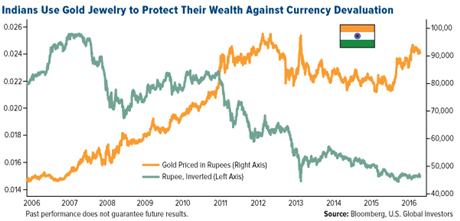
This has been the case in countless past examples. Rogoff himself cites Indians’ longstanding love of and cultural affinity to gold jewelry as protection against currency uncertainty. For centuries, inhabitants of the Indian subcontinent saw continuous regime change, not to mention imperialist rule by various European forces. During all this time, the one stable and widely accepted currency was gold.

image: http://www.stockhouse.com/getattachment/83c36518-3127-495e-ba64-6fedceb70f48/frank_919_3-(1).png

frank_919_3-(1).png

The tradition carries on today. A third of Indian gold jewelry demand comes from rural farmers, who annually convert a portion of their crop revenues into the yellow metal. Whether this gold is stored or given to a female family member, perhaps a daughter, before her wedding day, its purpose is twofold: one, as a beautiful heirloom to be worn and passed down to the next generation, and two, as a form of financial security.

It’s estimated that Indian households currently hold more than 20,000 tonnes of gold. To put that in perspective, 20,000 tonnes is more than the official gold holdings of the U.S., Germany, Italy, France, China and Russia combined.

With speculation strong that a rupee devaluation is imminent, it makes just as much sense now as ever for Indians to have at least some of their wealth in gold. When the rupee unexpectedly dipped to record lows in August 2013, the wealth that prudent Indians had stored in the precious metal was, for the time being, safe.

image: http://www.stockhouse.com/getattachment/f2a16064-fb6c-4ca9-8dc6-778821d7f7e0/frank_919_4.png
frank_919_4.png

Although there’s little fear right now that the U.S. dollar is in trouble, I still recommend that investors maintain a 10 percent weighting in gold—5 percent in gold stocks, 5 percent in gold coins and jewelry.

Is Chicago Next to Declare Bankruptcy?

It’s not just Indian investors who should be aware of currency fluctuations and imbalances in monetary and fiscal policy. These can happen right here in our own backyards, and investors who aren’t paying attention—specifically municipal bond investors—could pay a steep price.

In the past few years, we’ve seen how financial mismanagement can bring calamity to state and local economies, the most notable example being Detroit’s $18 billion bankruptcy in July 2013, the largest in U.S. history. Right now, the U.S. territory of Puerto Rico is in dire financial straits, owing some $70 billion, more than any state government except California and New York.

And then there’s Chicago, which is looking at $170 billion in unfunded pensions and other costs.

This came to my attention earlier this month when I visited Chicago to attend the Morningstar ETF Conference. While there, I had the opportunity to speak to several locals, who shared with me their frustration of high local tax rates—some of the highest in the country.

Taxes are high, they said, mainly because of outrageous pensions for public and union workers. Entitlement spending has exploded. Now, Chicago, which has the lowest credit rating of any major U.S. city, is edging scarily close to bankruptcy.

Unfortunately, it isn’t hard to see why. For starters, the state has one of the most highly unionized workforces in the country, compared to the national average.

image: http://www.stockhouse.com/getattachment/787a431e-5c0a-41e8-9492-97ff183d748c/frank_919_5.png

frank_919_5.png

And instead of reining in costs, state and city officials continue to add to the pile of debt. The Land of Lincoln already has the least funded retirement system in the country, according to Bloomberg, and is on track to end the year $7.8 billion in the hole.

Lawmakers and other government workers are among the highest paid in the nation and enjoy “Cadillac” health care benefits and pensions. It’s not uncommon for them to retire in their 50s. The Illinois Policy Institute estimates that the total annual operating cost for each state lawmaker—including salary, insurance and the like—stands at more than $100,000, with private taxpayers footing most of the bill.

“It’s like we work for the government,” one Chicagoan told me. “Everything we make goes to their pensions.”

Conveniently, the state constitution includes a clause that forbids any reduction of public pensions.

For these reasons, Illinois is saddled with some of the highest income and corporate taxes in the United States. Chicago’s sales tax is the highest of any major U.S. city. Despite the revenue this generates, it doesn’t come close to touching what’s been promised.

Look at the chart below. Between 2000 and 2015, Illinois tax revenue increased 57 percent. That’s a significant jump. But over the same period, state-employee insurance and pension benefits skyrocketed—166 and 586 percent respectively—while essential services such as higher education suffered.

image: http://www.stockhouse.com/getattachment/a9380262-5c6f-40ab-8b22-6e7620bbb809/frank_919_6.png

frank_919_6.png

What this means is very little of taxpayers’ money is going toward anything tangible—new schools, new hospitals, new wastewater treatment plants. Nothing that provides jobs or has a multiple effect is being produced.

We’re already seeing serious consequences as a result of the state and city’s fiscal woes. In a recent study of jobs market competitiveness, CareerBuilder found that Chicago is the least competitive metropolitan area in the U.S. in terms of jobs growth. Between 2014 and 2015, the Windy City’s rate of adding jobs was far short of the national average.

Because of this—among other reasons, including crime, unemployment and political infighting—Chicago had the largest population loss of any metro in the U.S last year (6,263). Meanwhile, Illinois was one of only seven states to see a net decline (22,194).

And where are these people going? Where the jobs are, of course. I always say that money flows where it’s most respected. People behave the same way.

It’s no wonder, then, that the state that attracts the most Illinois expats is Texas, according to the Chicago Tribune. This falls in line with what I wrote just a couple of weeks ago. Between 2014 and 2015, Texas added more residents than any other state because of its strong economy, abundance of jobs and low taxes. CareerBuilder’s jobs study, I should point out, rated Dallas as the most competitive city. And within the next eight to 10 years, Houston is expected to surpass Chicago to become the nation’s third largest city by population.

I’m not saying this to beat up on Chicago, but to emphasize my earlier point about being aware and prepared—especially, in this case, when it comes to municipal bond investing. Many passive muni funds might hold Chicago debt because it’s high-yielding. But those yields could come at a huge cost. Three years ago, bondholders of Detroit’s bad debt learned the hard way that, in the event of a default, pensioners get paid first, investors last—or worse, not at all.

As active managers we’re well aware of this. We sincerely hope Chicago can straighten out its balance sheet, but in the meantime, we feel it’s not a space to be a buyer right now. Instead, we seek to invest primarily in high-quality, short-term munis, and that means staying away from irresponsible government policy.

LEARN MORE ABOUT SHORT-TERM MUNIS

The Consumer Price Index (CPI) is one of the most widely recognized price measures for tracking the price of a market basket of goods and services purchased by individuals.  The weights of components are based on consumer spending patterns.

Holdings may change daily. Holdings are reported as of the most recent quarter-end. None of the securities mentioned in the article was held by any accounts managed by U.S. Global Investors as of 6/30/2016.

All opinions expressed and data provided are subject to change without notice. Some of these opinions may not be appropriate to every investor. By clicking the link(s) above, you will be directed to a third-party website(s). U.S. Global Investors does not endorse all information supplied by this/these website(s) and is not responsible for its/their content.

U.S. Global Investors, Inc. is an investment adviser registered with the Securities and Exchange Commission (“SEC”). This does not mean that we are sponsored, recommended, or approved by the SEC, or that our abilities or qualifications in any respect have been passed upon by the SEC or any officer of the SEC.

This commentary should not be considered a solicitation or offering of any investment product.

Certain materials in this commentary may contain dated information. The information provided was current at the time of publication.
Read more at http://www.stockhouse.com/opinion/independent-reports/2016/09/19/the-war-on-cash-still-good-for-gold#B2tsLUDJLQZ13xKu.99

By Frank Holmes

Full Article : The War on Cash is Still Good for Gold

Disclaimer© 2010 Junior Gold ReportJunior Gold Report’ Newsletter: Junior Gold Report’s Newsletter is published as a copyright publication of Junior Gold Report (JGR). No Guarantee as to Content: Although JGR attempts to research thoroughly and present information based on sources we believe to be reliable, there are no guarantees as to the accuracy or completeness of the information contained herein. Any statements expressed are subject to change without notice. JGR, its associates, authors, and affiliates are not responsible for errors or omissions. Consideration for Services: JGR, it’s editor, affiliates, associates, partners, family members, or contractors may have an interest or position in featured, written-up companies, as well as sponsored companies which compensate JGR. JGR has been paid by the company written up. Thus, multiple conflicts of interests exist. Therefore, information provided herewithin should not be construed as a financial analysis but rather as an advertisement. The author’s views and opinions regarding the companies featured in reports are his own views and are based on information that he has researched independently and has received, which the author assumes to be reliable. No Offer to Sell Securities: JGR is not a registered investment advisor. JGR is intended for informational, educational and research purposes only. It is not to be considered as investment advice. Subscribers are encouraged to conduct their own research and due diligence, and consult with their own independent financial and tax advisors with respect to any investment opportunity. No statement or expression of any opinions contained in this report constitutes an offer to buy or sell the shares of the companies mentioned herein. Links: JGR may contain links to related websites for stock quotes, charts, etc. JGR is not responsible for the content of or the privacy practices of these sites. Release of Liability: By reading JGR, you agree to hold Junior Gold Report its associates, sponsors, affiliates, and partners harmless and to completely release them from any and all liabilities due to any and all losses, damages, or injuries (financial or otherwise) that may be incurred.

Forward Looking Statements
Except for statements of historical fact, certain information contained herein constitutes forward-looking statements. Forward looking statements are usually identified by our use of certain terminology, including “will”, “believes”, “may”, “expects”, “should”, “seeks”, “anticipates”, “has potential to”, or “intends’ or by discussions of strategy, forward looking numbers or intentions. Such forward-looking statements involve known and unknown risks, uncertainties and other factors which may cause our actual results or achievements to be materially different from any future results or achievements expressed or implied by such forward-looking statements. Forward-looking statements are statements that are not historical facts, and include but are not limited to, estimates and their underlying assumptions; statements regarding plans, objectives and expectations with respect to the effectiveness of the Company’s business model; future operations, products and services; the impact of regulatory initiatives on the Company’s operations; the size of and opportunities related to the market for the Company’s products; general industry and macroeconomic growth rates; expectations related to possible joint and/or strategic ventures and statements regarding future performance. Junior Gold Report does not take responsibility for accuracy of forward looking statements and advises the reader to perform own due diligence on forward looking numbers or statements.


Hillary or Donald? Who Cares?

0

Full Article: Hillary or Donald? Who Cares? 

By: Michael Campbell, Money Talks

I don’t think anyone in the commentariat shows any sign of understanding what is revealed by the two political quotes below. The first quote is my favorite because it sums up my sentiments.

Gary Johnson, the presidential candidate for the Libertarian Party in the US was asked during his appearance on The View whether he would vote Clinton or Trump if someone had a gun to his head. He replied: “I’d let the gun go off.”

The second quote is representative of the mainstream media. Its a generalization but I think the evidence supports it. It was made this week by New York Magazine writer Jonathan Chait:

“the average undecided voter is getting snippets of news from television personalities like Matt Lauer who are failing to convey the fact that the election pits a normal politician with normal political feelings against an ignorant, bigoted, pathologically dishonest authoritarian.”

Some ask why I look at politics. To be blunt, understanding political trends is pivotal to understanding major investment trends –  from the Canadian dollar’s value to real estate and of course stocks. The capital flows that move investments and currencies are driven by confidence, primarily in government. Last year 1.3 trillion dollars moved out of Russia, 1.2 trillion out of China.  I think most of us understand, for example, that money moving out of China has been a major mover of high-end real estate in Vancouver, Toronto, New York, Melbourne and Sydney. Russia has been a big player in London and New York.

The biggest player on the world stage though is the US and that’s why I’m focusing on it. It has the biggest capital flows in both directions and what we’re seeing in this election is unprecedented, and it will be a pivotal catalyst for the financial and social chaos that’s to come. At Money Talks World Outlook Conference with Martin Armstrong and on the Money Talks show I’ve been unequivocal that the next four years are going to make the extreme volatility and the social and economic dislocation of the last seven years seem like the good old days.

With that said let me come back to New York magazine writer Jonathan Chait’s statement that: “the election pits a  normal politician with normal political feelings against an ignorant, bigoted, pathologically dishonest, authoritarian.”

My reading is that this represents the commentariats prevailing view. They are on the side that says that Hillary Clinton’s unethical behavior, her outright lying that I would characterize as the worst in the political establishment, is better than the bombastic ill-conceived passing acquaintance with the truth that Donald Trump displays. That focus completely misses the big picture. It makes no difference if you think that Donald Trump couldn’t be worse with what’s going on now. Or as other people i know think that anything would be better than Donald. What the commentariat seems oblivious to, is that this election marks a key point in the demise of confidence in government. Each candidate is profoundly polarizing, and whoever wins the presidency is going to start with the highest disapproval rating in history, somewhere around sixty percent. They will preside over the next leg of the entitlement crisis that’s already claimed Detroit, Stockton, Chicago and Puerto Rico. At some point we’ll stop ignoring this but I can’t emphasize enough that the entitlement crisis going to be pivotal.

When I first read Mr. Chait’s quote on Hillary Clinton, that she’s a normal politician with normal political feelings, I thought “If she’s the norm the system deserves to unravel”. But it’s more than that. The commentariat seem completely out of touch with the suffering and hardship that so many experience. I’ve mentioned this a lot in conjunction with our own debate over oil and pipelines and not once have I ever heard the leaders of the anti pipeline and anti oil movement even mention the massive job losses and dislocation happening in certain communities. It’s not even acknowledged, and this kind of bottom line elitism is what fuels the discontent.

As well known New York Times columnist David Brooks said, “Trump voters are a coalition of the dispossessed. They’ve suffered job losses, lost wages, lost dreams. The American system is not working for them so naturally they’re looking for something else.” Many in the media, especially me, did not understand just how they would express their alienation. We expected Trump to fizzle because we’re not socially intermingled with his supporters and did not listen carefully enough. I think that’s a beautiful summation of the Canadian mainstream media, and also in the States. Mr. Brooks got the message, but I see little evidence that the vast majority of the commentariat or the political establishment has. They didn’t see the Brexit vote coming. They seem oblivious to what happened in Greece with the election of the newly formed Syriza party. No thoughts on the upcoming election in Austria where they Anti-Eu party will win. The defeat of Angela Merkel’s party in regional elections in Germany last week? No. No thoughts on any of those dramatic changes.

The question of who or what comes next is the key political and economic question for the next decade. The election of Hillary Clinton, the ultimate elitist establishment Wall Street candidate, (as Bernie Sanders said) is going to exacerbate the trend. The backlash against the political elite has begun and the trend is going to be propelled by litany of broken promises by the welfare state starting with unfunded public sector pensions compounded by major debt problems.

That’s the big picture to understand, not what your political favorite is.

~ Michael Campbell

Read more at http://www.stockhouse.com/news/newswire/2016/09/16/hillary-or-donald-who-cares#LRfYBKMklJcSziA0.99

Stock Trading Alert: Positive Expectations Following Last Week’s Uncertainty, But Will Stocks Continue Higher?

0


Stock Trading Alert originally published on September 19,  2016, 6:54 AM:

Briefly: In our opinion, speculative short positions are favored (with stop-loss at 2,210, and profit target at 2,050, S&P 500 index).

Our intraday outlook is bearish, and our short-term outlook is bearish. Our medium-term outlook is now neutral, following S&P 500 index breakout above last year’s all-time high:

Intraday outlook (next 24 hours): bearish
Short-term outlook (next 1-2 weeks): bearish
Medium-term outlook (next 1-3 months): neutral
Long-term outlook (next year): neutral

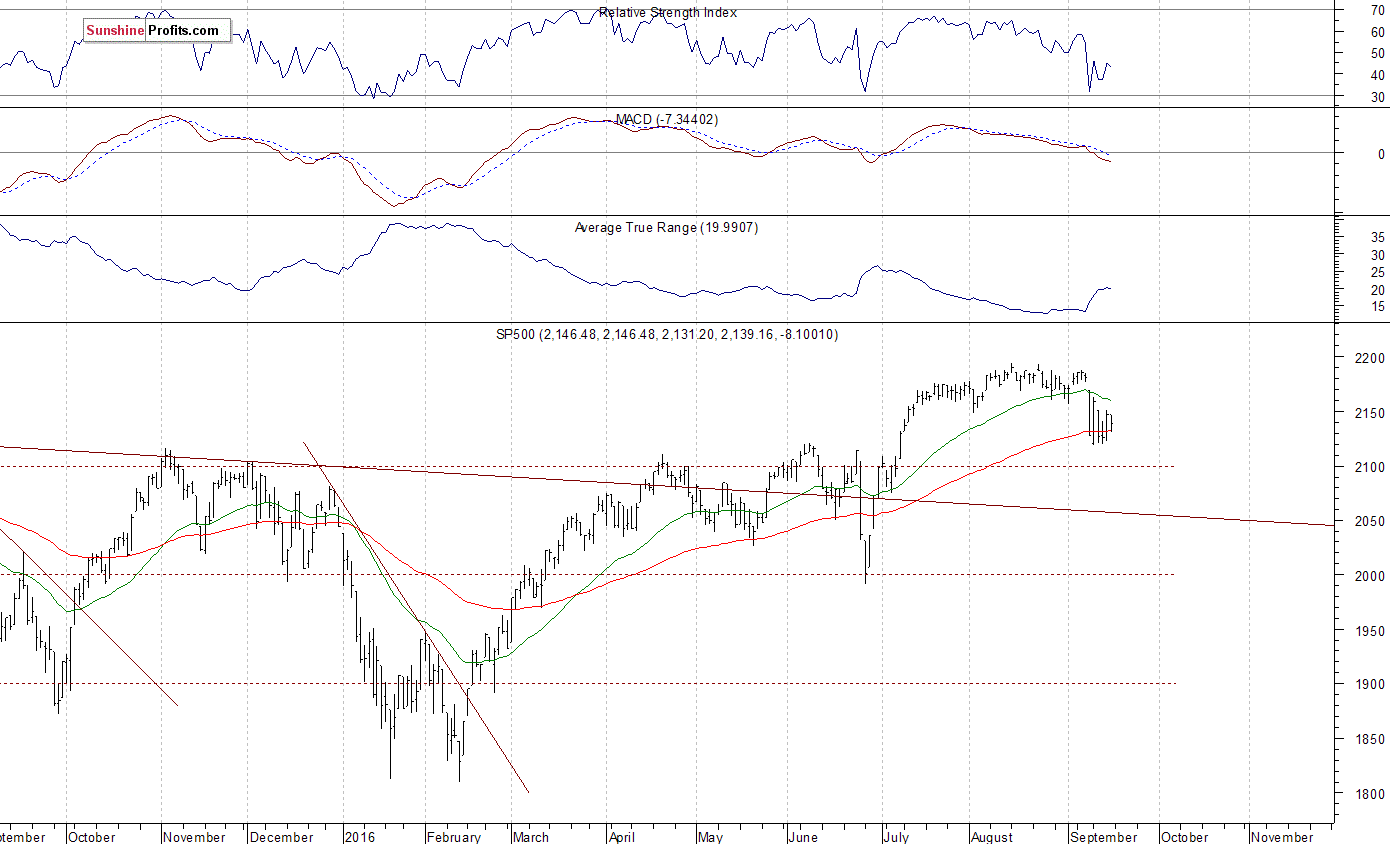
The main U.S. stock market indexes were mixed between -0.5% and 0.0% on Friday, extending their short-term uncertainty, as investors reacted to economic data announcements, among others. The S&P 500 index remains within a consolidation following recent move down. It continues to trade below its two-month-long consolidation following June – July rally. Is this a new downtrend or just quick downward correction? The nearest important level of resistance is at around 2,170, marked by Friday’s daily gap down of 2,169.08-2,177.49. On the other hand, support level is at 2,120-2,130, marked by recent local lows, as we can see on the daily chart:

1-1

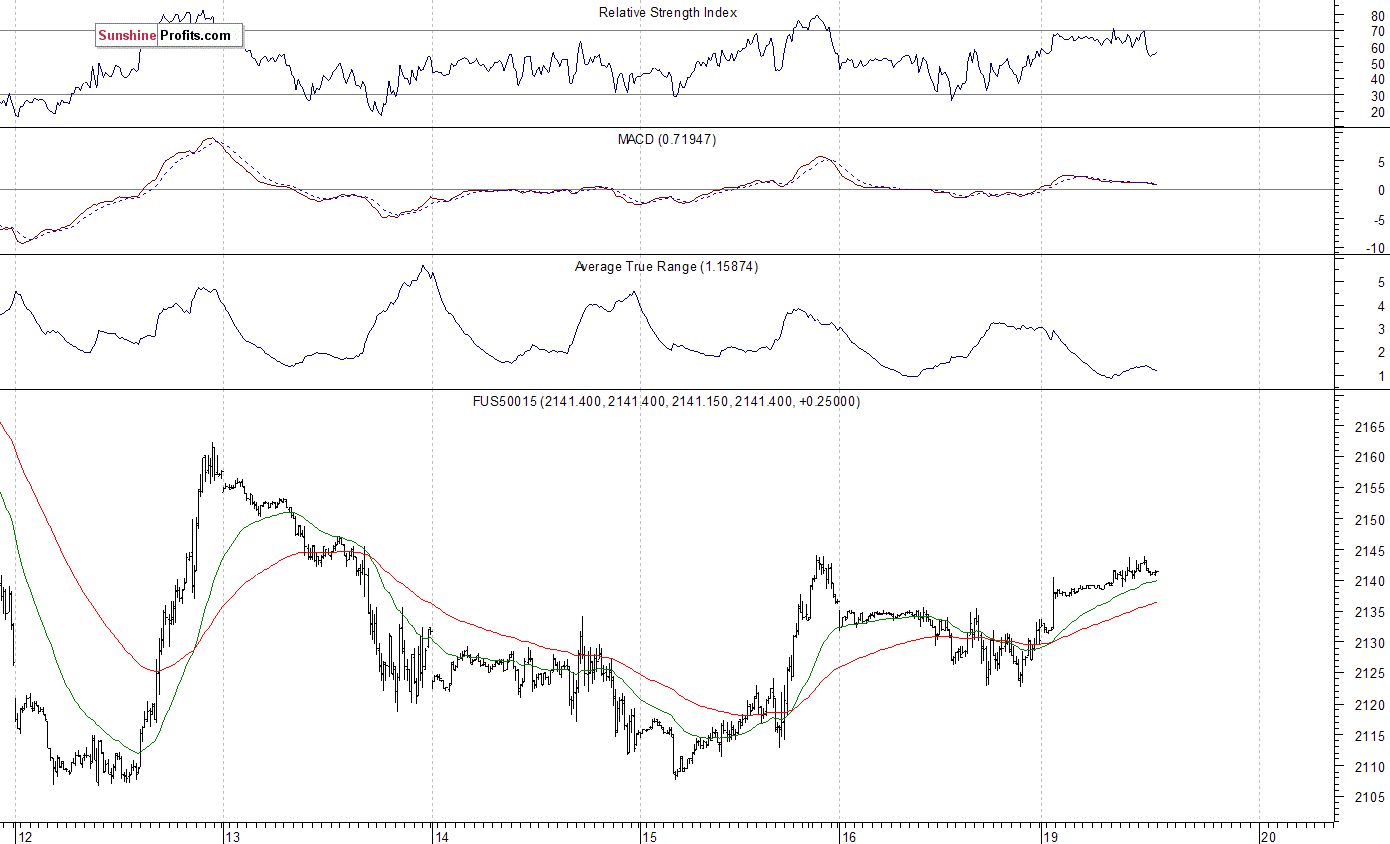
Expectations before the opening of today’s trading session are positive, with index futures currently up 0.4%. The European stock market indexes have gained 0.8-1.4% so far. Investors will now wait for the NAHB Housing Market Index release at 10:00 a.m. The S&P 500 futures contract trades within an intraday uptrend, as it retraces its Friday’s move down. The nearest important level of resistance is at around 2,140-2,150, marked by short-term local high. On the other hand, support level remains at 2,120, among others:

2-1

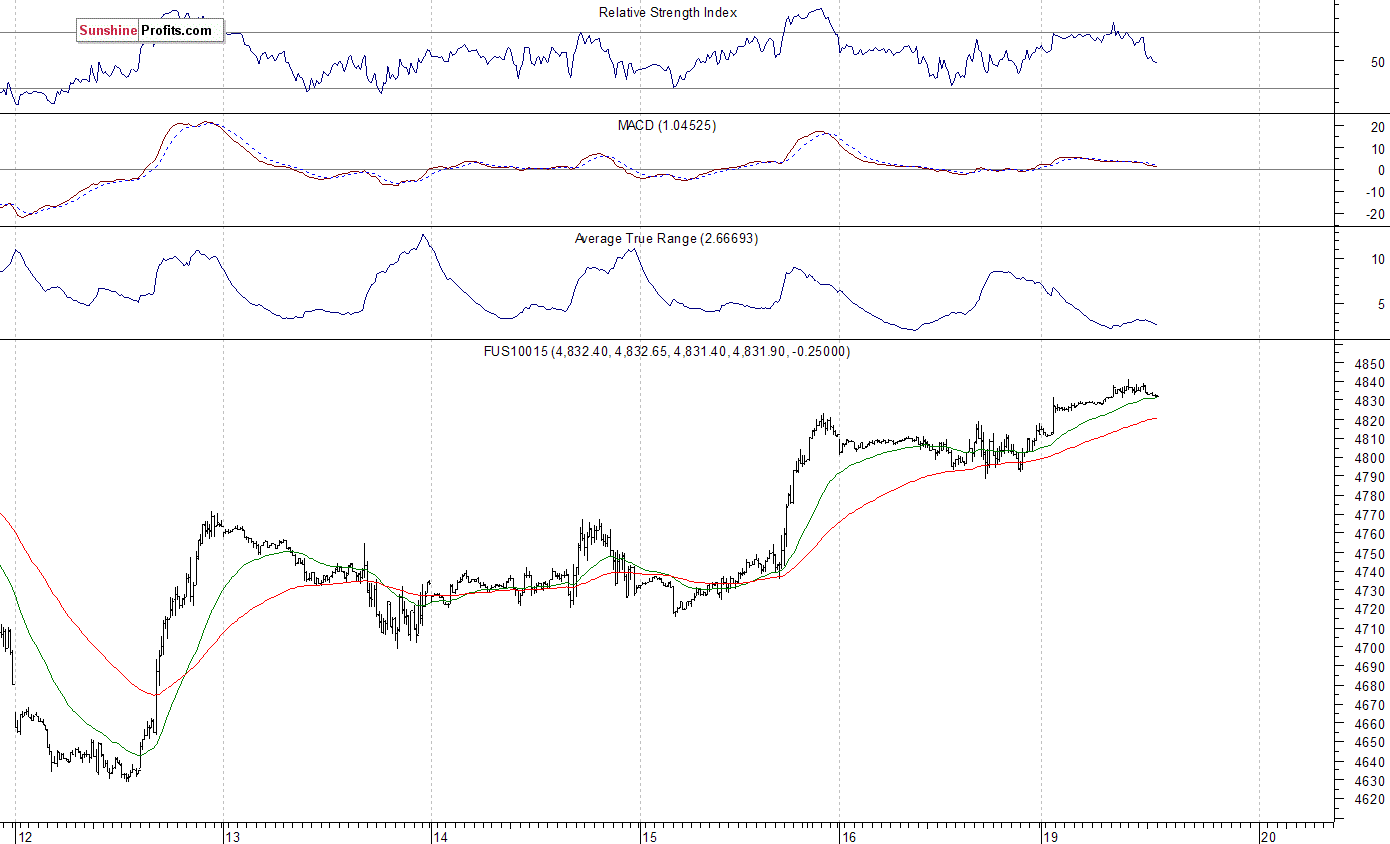
The technology Nasdaq 100 futures contract is relatively stronger than the broad stock market, as it currently trades close to its September’s all-time high. The nearest important level of resistance is at around 4,840-4,850. On the other hand, support level remains at around 4,800-4,820, marked by previous resistance level, as the 15-minute chart shows:

3-1

Concluding, the broad stock market extends its consolidation following recent breakdown below two-month-long fluctuations. There have been no confirmed positive signals so far. Therefore, we continue to maintain our speculative short position (opened on July 18th at 2,162, S&P 500 index). Stop-loss level is at 2,210 and potential profit target is at 2,050 (S&P 500 index). You can trade S&P 500 index using futures contracts (S&P 500 futures contract – SP, E-mini S&P 500 futures contract – ES) or an ETF like the SPDR S&P 500 ETF – SPY. It is always important to set some exit price level in case some events cause the price to move in the unlikely direction. Having safety measures in place helps limit potential losses while letting the gains grow.

Thank you.

Paul Rejczak
Stock Trading Strategist
Stock Trading Alerts
SunshineProfits.com

Disclaimer

All essays, research and information found above represent analyses and opinions of Paul Rejczak and Sunshine Profits’ associates only. As such, it may prove wrong and be a subject to change without notice. Opinions and analyses were based on data available to authors of respective essays at the time of writing. Although the information provided above is based on careful research and sources that are believed to be accurate, Paul Rejczak and his associates do not guarantee the accuracy or thoroughness of the data or information reported. The opinions published above are neither an offer nor a recommendation to purchase or sell any securities. Mr. Rejczak is not a Registered Securities Advisor. By reading Paul Rejczak’s reports you fully agree that he will not be held responsible or liable for any decisions you make regarding any information provided in these reports. Investing, trading and speculation in any financial markets may involve high risk of loss. Paul Rejczak, Sunshine Profits’ employees and affiliates as well as members of their families may have a short or long position in any securities, including those mentioned in any of the reports or essays, and may make additional purchases and/or sales of those securities without notice.

Disclaimer© 2010 Junior Gold ReportJunior Gold Report’ Newsletter: Junior Gold Report’s Newsletter is published as a copyright publication of Junior Gold Report (JGR). No Guarantee as to Content: Although JGR attempts to research thoroughly and present information based on sources we believe to be reliable, there are no guarantees as to the accuracy or completeness of the information contained herein. Any statements expressed are subject to change without notice. JGR, its associates, authors, and affiliates are not responsible for errors or omissions. Consideration for Services: JGR, it’s editor, affiliates, associates, partners, family members, or contractors may have an interest or position in featured, written-up companies, as well as sponsored companies which compensate JGR. JGR has been paid by the company written up. Thus, multiple conflicts of interests exist. Therefore, information provided herewithin should not be construed as a financial analysis but rather as an advertisement. The author’s views and opinions regarding the companies featured in reports are his own views and are based on information that he has researched independently and has received, which the author assumes to be reliable. No Offer to Sell Securities: JGR is not a registered investment advisor. JGR is intended for informational, educational and research purposes only. It is not to be considered as investment advice. Subscribers are encouraged to conduct their own research and due diligence, and consult with their own independent financial and tax advisors with respect to any investment opportunity. No statement or expression of any opinions contained in this report constitutes an offer to buy or sell the shares of the companies mentioned herein. Links: JGR may contain links to related websites for stock quotes, charts, etc. JGR is not responsible for the content of or the privacy practices of these sites. Release of Liability: By reading JGR, you agree to hold Junior Gold Report its associates, sponsors, affiliates, and partners harmless and to completely release them from any and all liabilities due to any and all losses, damages, or injuries (financial or otherwise) that may be incurred.

Forward Looking Statements
Except for statements of historical fact, certain information contained herein constitutes forward-looking statements. Forward looking statements are usually identified by our use of certain terminology, including “will”, “believes”, “may”, “expects”, “should”, “seeks”, “anticipates”, “has potential to”, or “intends’ or by discussions of strategy, forward looking numbers or intentions. Such forward-looking statements involve known and unknown risks, uncertainties and other factors which may cause our actual results or achievements to be materially different from any future results or achievements expressed or implied by such forward-looking statements. Forward-looking statements are statements that are not historical facts, and include but are not limited to, estimates and their underlying assumptions; statements regarding plans, objectives and expectations with respect to the effectiveness of the Company’s business model; future operations, products and services; the impact of regulatory initiatives on the Company’s operations; the size of and opportunities related to the market for the Company’s products; general industry and macroeconomic growth rates; expectations related to possible joint and/or strategic ventures and statements regarding future performance. Junior Gold Report does not take responsibility for accuracy of forward looking statements and advises the reader to perform own due diligence on forward looking numbers or statements.

A better way to mine gold from old electronics

0

Full Article: A better way to mine gold from old electronics

By  Michael Franco

When you get rid of an old phone or tablet, you’re likely to remove your valuable information from it, but what about the valuable materials – like gold – that it contains?

Naturally, such substances are too hard for consumers to retrieve, which might be why, according to the University of Edinburgh (UE), about seven percent of the world’s gold supply is currently locked inside of electronics. While removing that gold has heretofore been a highly toxic and inefficient proposition, researchers now think that a new process will make prospecting for gold in electronics heaps more achievable than ever.

Gold is often found on printed circuit boards, particularly under keyboards where its durability is an advantage. According to the UE researchers, about 300 tonnes of the metal are used in electronics each year.

The new process to remove it uses a mild acid as opposed to harsher chemicals such as cyanide or mercury that are currently used to extract gold.

First, printed circuit boards are dissolved in the acid which turns all of the metal in the board to liquid. Then, an oily solvent made from toluene is added, kicking off a process known as solvent extraction. Toluene is an aromatic hydrocarbon commonly found in paint thinners. The toluene solvent pulls the gold free from the other materials in the acid wash where the metal can be recovered and used again. Likewise, the solvent and acid can be reused, cutting down on waste.

“The solvent extraction technique is great in that the recycling of reagents and acid are integral to the process,” lead researcher Jason Love of UE’s School of Chemistry told New Atlas.

Love also says that it might be possible to extract other metals using the process.

“Once you have dissolved metals in acid, you can use solvent extraction to separate all of them,” he said. “So, in principle, we could devise a process that would be able to separate all of the metals in electronic waste, which of course would have environmental and potentially economic benefits, but this would depend on the prices of metals and the cost of the process.”

The work Love and his team carried out is part of a student- and staff-led initiative at UE to promote the circular economy, which focuses on the efficient use of materials and their reuse as well.

Source: University of Edinburgh

Full Article: A better way to mine gold from old electronics

By  Michael Franco

Disclaimer© 2010 Junior Gold ReportJunior Gold Report’ Newsletter: Junior Gold Report’s Newsletter is published as a copyright publication of Junior Gold Report (JGR). No Guarantee as to Content: Although JGR attempts to research thoroughly and present information based on sources we believe to be reliable, there are no guarantees as to the accuracy or completeness of the information contained herein. Any statements expressed are subject to change without notice. JGR, its associates, authors, and affiliates are not responsible for errors or omissions. Consideration for Services: JGR, it’s editor, affiliates, associates, partners, family members, or contractors may have an interest or position in featured, written-up companies, as well as sponsored companies which compensate JGR. JGR has been paid by the company written up. Thus, multiple conflicts of interests exist. Therefore, information provided herewithin should not be construed as a financial analysis but rather as an advertisement. The author’s views and opinions regarding the companies featured in reports are his own views and are based on information that he has researched independently and has received, which the author assumes to be reliable. No Offer to Sell Securities: JGR is not a registered investment advisor. JGR is intended for informational, educational and research purposes only. It is not to be considered as investment advice. Subscribers are encouraged to conduct their own research and due diligence, and consult with their own independent financial and tax advisors with respect to any investment opportunity. No statement or expression of any opinions contained in this report constitutes an offer to buy or sell the shares of the companies mentioned herein. Links: JGR may contain links to related websites for stock quotes, charts, etc. JGR is not responsible for the content of or the privacy practices of these sites. Release of Liability: By reading JGR, you agree to hold Junior Gold Report its associates, sponsors, affiliates, and partners harmless and to completely release them from any and all liabilities due to any and all losses, damages, or injuries (financial or otherwise) that may be incurred.

Forward Looking Statements
Except for statements of historical fact, certain information contained herein constitutes forward-looking statements. Forward looking statements are usually identified by our use of certain terminology, including “will”, “believes”, “may”, “expects”, “should”, “seeks”, “anticipates”, “has potential to”, or “intends’ or by discussions of strategy, forward looking numbers or intentions. Such forward-looking statements involve known and unknown risks, uncertainties and other factors which may cause our actual results or achievements to be materially different from any future results or achievements expressed or implied by such forward-looking statements. Forward-looking statements are statements that are not historical facts, and include but are not limited to, estimates and their underlying assumptions; statements regarding plans, objectives and expectations with respect to the effectiveness of the Company’s business model; future operations, products and services; the impact of regulatory initiatives on the Company’s operations; the size of and opportunities related to the market for the Company’s products; general industry and macroeconomic growth rates; expectations related to possible joint and/or strategic ventures and statements regarding future performance. Junior Gold Report does not take responsibility for accuracy of forward looking statements and advises the reader to perform own due diligence on forward looking numbers or statements.