Home Blog Page 219

Brexit Plows into British Consumers, Economy to Spiral Down

0

by Wolf Richter

Consumer confidence plunges the most since 1994.

Britons’ economic sentiment, already sagging since the summer of 2014, has dropped after the Brexit vote at the steepest rate since 1994!

We can’t blame them. The pound sterling plunged 25% over the last 12 months in anticipation of the Brexit vote, and in its aftermath. A bevy of usual suspects, including Goldman Sachs, Deutsche Bank, and Citigroup, are nowproclaiming that the pound could fall another 7% to 11%. Deutsche Bank figures the pound, now at $1.29, could drop to $1.15 by the end of the year.

The initial plunge after Brexit was a reaction to Brexit, they say. But now there’s a second wave of selling on the way in reaction to the Bank of England’s reaction to Brexit.

Forecasters have a history of being wrong, but the current level is real. The destruction of the pound may be good for UK exporters, but it’s terrible for consumers. They buy a lot of imported stuff, and that stuff is about to get more expensive. And forget about going abroad this summer. Can’t afford it anymore.

The financial prognosticators – normally not a doom-and-gloom crowd – weren’t shy about dooming and glooming. Daiwa Capital Markets in a notetitled, “Political Anarchy, Economic Calamity,” added some bitter flavors:

The UK is “in the midst of its deepest political crisis since at least the Second World War, with a vacuum at the top of Government.” At the same time, “the Leave campaigners have no plan how to actually put the Brexit vote into practice.” They’re “displaying a woeful ignorance of the EU’s rules, and appear completely naïve about the motivations and red lines of the UK’s EU counterparts…. And while they think that the EU will be able to cut the UK a special deal, they are deluded.”

All the while, EU Leaders have displayed what is, for them, remarkable unity….

But for the UK economy, “this uncertainty is clearly a massive negative,” with a recession now being “the consensus call”:

We expect a sharp contraction in investment due to the hit on business confidence and significantly lower consumption growth as real incomes get squeezed by rising inflation resulting from the sharp depreciation in sterling (which we expect to fall further from here) and rising unemployment as firms adjust workforces downwards. At the same time, uncertainty will hit construction activity and real estate transactions – and any falls in house prices will serve to put further downward pressure on consumption growth.

And that boost to exports due to the crushed pound? Forget it. It’s “unlikely to boost exports significantly, not least given the uncertainty over the UK’s future trading arrangements.”

The situation could still get worse than Daiwa’s forecast, the note said, with the economy deteriorating more sharply, inflation rising faster, and investment grinding down:

This is particularly true for investment from overseas, where uncertainty about whether the UK will continue to maintain access to the Single Market, a key reason why the UK has the second largest stock of foreign direct investment in the world, is likely to see foreign firms freeze investment plans.

Given the UK’s current account deficit of 6.9% of GDP, this lack of foreign investment “is also potentially dangerous for sterling given the UK’s need for large inflows of foreign capital to pay its way.” At the same time, “attracting the required foreign capital is going to be much more difficult post-referendum.”

Amid this political and economic uncertainty that may hang around “probably years to come,” British consumers have lost their mojo.

According to the special post-Brexit GfK Consumer Confidence Barometer(CCB), the core index plunged to -9, from an already low -1 just before the vote. It was the steepest plunge since December 1994. It was down 16 points from the halcyon days of June 2015, when the index still stood at +7.

These aspects got hammered in particular:

  • “General economic situation” over the last 12 months dropped to -19, from -13 just before Brexit, and from +4 a year ago.
  • “General economic situation” over the next 12 months, oh my! 60% expect it to worsen; only 20% expect it to improve! So the index plunged 15 points to -29, last seen during the euro debt crisis in 2011 and 2012. It’s down 33 points from a year ago. The index has been deteriorating since the post-Financial Crisis high in the summer of 2014. Another drop of this sort will plant it in Financial-Crisis gloom.
  • “Major purchases” dropped 12 points to -3 and is down 19 points from a year ago. “Now is a good time to save” hit the highest point since October 2008. This doesn’t bode well for consumer spending.

The confidence of households with incomes between £25,000 and £50,000 ($32,000-$65,000) took the biggest hit, plunging 16 points. So there will be real consequences, among them:

Our analysis suggests that in the immediate aftermath of the referendum, sectors like travel, fashion and lifestyle, home, living, DIY, and grocery are particularly vulnerable to consumers cutting back their discretionary spending.

With business investment entering the deep-freeze until some modicum of certainty returns to the political and economic environment in the UK and its trading relationships, and with hiring grinding to a halt until further notice, solid consumer spending would be a godsend. But no. With this bashed consumer confidence, gloomy outlook, and intentions to save more and spend less, given all the uncertainty, the UK economy looks to enter a world of hurt – just when global demand is already languishing.

It’s not like Europe doesn’t already have enough problems, including a blooming banking crisis. Among the worst is Deutsche Bank, whose bond-buyback miracle-nonsense earlier this year flopped miserably, and whose shares and CoCo bonds plunged. Read…    I’m in Awe at How Fast Deutsche Bank is Coming Unglued

full article: http://wolfstreet.com/2016/07/08/british-consumer-confidence-plunges-post-brexit-economy-to-spiral-down/

Disclaimer © 2010 Junior Gold Report
Junior Gold Report’ Newsletter: Junior Gold Report’s Newsletter is published as a copyright publication of Junior Gold Report (JGR). No Guarantee as to Content: Although JGR attempts to research thoroughly and present information based on sources we believe to be reliable, there are no guarantees as to the accuracy or completeness of the information contained herein. Any statements expressed are subject to change without notice. JGR, its associates, authors, and affiliates are not responsible for errors or omissions.

Forward Looking Statements
Except for statements of historical fact, certain information contained herein constitutes forward-looking statements. Forward looking statements are usually identified by our use of certain terminology, including “will”, “believes”, “may”, “expects”, “should”, “seeks”, “anticipates”, “has potential to”, or “intends’ or by discussions of strategy, forward looking numbers or intentions. Such forward-looking statements involve known and unknown risks, uncertainties and other factors which may cause our actual results or achievements to be materially different from any future results or achievements expressed or implied by such forward-looking statements. Forward-looking statements are statements that are not historical facts, and include but are not limited to, estimates and their underlying assumptions; statements regarding plans, objectives and expectations with respect to the effectiveness of the Company’s business model; future operations, products and services; the impact of regulatory initiatives on the Company’s operations; the size of and opportunities related to the market for the Company’s products; general industry and macroeconomic growth rates; expectations related to possible joint and/or strategic ventures and statements regarding future performance. Junior Gold Report does not take responsibility for accuracy of forward looking statements and advises the reader to perform own due diligence on forward looking numbers or statements.

4 winners to emerge from Brexit

0

Article by: Frank Holmes

Last week my friend John Mauldin, chairman of Mauldin Economics, released a special Brexit edition of his popular investments newsletter Outside the Box. In it he shared a post written by geopolitical strategist George Friedman that describes a recent meeting among six foreign ministers representing the European Union’s founding member states: Belgium, France, Germany, Italy, Luxembourg and the Netherlands. The topic of discussion was the possible causes and implications of the U.K.’s decision to leave the EU.

What George finds extraordinary is that, in their follow-up statement, the ministers appear to capitulate, admitting they “recognize different levels of ambition amongst Member States when it comes to the project of European integration.”

As George puts it, this is their way of acknowledging—finally?—the impossible task of enforcing uniformity across the European continent, home to many different peoples and cultures, all with different goals and aspirations.

If nothing else, this alone should be seen as a positive consequence of Brexit. It’s too early to tell what direction the EU will take post-Brexit, or whether any material policy changes will be made, but it seems as if the cries of resentment and frustration that have risen up from England and Wales (and, to a lesser extent, Scotland and Northern Ireland) have not fallen on deaf ears.

This is precisely what I’ve been writing about the last few weeks. If you’ve been following the mainstream media’s coverage of Brexit, you might think it’s little more than a reactionary, anti-immigrant groundswell. Don’t get me wrong—immigration is certainly part of it. Trying to integrate 50,000 people a year into the country’s national health care and school system has pushed the bandwidth of the British economy.

But the U.K.’s grievances—some of which I discussed in previous commentaries—are much more varied than that. And following the historic referendum, EU bureaucrats seem to be taking the gripes seriously, which we can count as a win not just for the U.K. but other member states as well.

Below are four more winners to have emerged from Brexit.

Gold Investors

The day after the referendum, gold jumped nearly 5 percent and since then has held above $1,300 an ounce, helping to achieve its best first half of the year since 1974. The yellow metal, which has historically been sought by investors during times of political and economic uncertainty, is also strengthening now that a U.S. interest rate hike seems less and less likely post-Brexit.

Markets, in fact, seem to have completely shed any belief that the Federal Reserve will raise rates this year. Bets that rates will be cut by September spiked before retreating, while bets that they would be left untouched surged 48.6 percent.

image: http://www.stockhouse.com/getattachment/737b0c2d-eff7-4a49-ab97-81b16cf25d37/frank_705_2.png

frank_705_2.png

This bodes well for gold, which has traditionally shared an inverse relationship with interest rates. When savings account rates and yields on government bonds are low, gold suddenly becomes much more attractive to hold as a store of value.
This is especially true in countries where rates are negative. The yield on the German 10-year Bund recently fell below zero, and the Swiss 30-year government bond yield turned negative, in effect charging investors for the privilege of holding their cash.

But American investors aren’t immune. Last Friday, the yield on the 10-year Treasury fell to as low as 1.385 percent, an all-time record.

Learn where the opportunities are in today’s gold market.

Across the pond, British rates are likely to be slashed this summer, according to Bank of England Governor Mark Carney. In response, Britain’s FTSE 100 Index roared up to a 10-month high, erasing all Brexit-inflicted losses.

image: http://www.stockhouse.com/getattachment/34ea8ed5-7106-4bdd-aba2-eef72cabd1c6/frank_705_3.png

frank_705_3.png

U.S. Homeowners

The promise of continued low rates in Brexit’s wake could be good news for U.S. homeowners, both current and potential. For the week ended June 24, the mortgage rate on a 30-year home loan fell to 3.75 percent, its lowest level since May 2013, according to the Mortgage Bankers Association. Some analysts are even forecasting mortgage rates—which tend to track 10-year Treasury yields—to sink to record lows in the coming weeks. This move is expected to spur a wave of new loan applications and refinancing as borrowers rush to lock in historically low rates.

image: http://www.stockhouse.com/getattachment/591cdaf2-f9a2-4f12-a2d6-b5cf0f1a15b7/frank_705_4.png

frank_705_4.png

Home prices in the U.S., meanwhile, continue to improve after the financial crisis. Prices advanced 5 percent year-over-year in April, according to new data from the S&P/Case-Shiller Home Prices Indices. The 20-City Composite Index, in fact, is back up to its winter 2007 level.

British Luxury Goods Makers

In the immediate aftermath of the U.K. referendum, Donald Trump suggested the pound’s dramatic decline could encourage more foreign tourists to visit Turnberry, Scotland, where he owns a luxury golf resort. Many in the media criticized him for the comment, arguing he seems to care only about how he might profit from Brexit. But the thing is, he’s right.

Because of the drop in the pound, which sent it to levels not seen in more than 30 years, U.S. and Chinese interest in travel to Britain has already seen a huge spike. This could be a potential windfall for Britain’s luxury goods industry, which posted sales averaging nearly $1 billion in 2014, according to advisory firm Deloitte. Clothing designer Burberry, Britain’s largest luxury company, could end up being a beneficiary, along with many other major European brands found in the U.K.

image: http://www.stockhouse.com/getattachment/574c7ac2-c3dd-4c6d-ab6f-f6da015e1d80/frank_705_5.png

frank_705_5.png

I’ve mentioned before how Chinese tourists spend more than any other country’s. Now, a March report by the World Travel & Tourism Council (WTTC) found that in 2015, outbound Chinese travelers shelled out a massive $215 billion overseas, representing an increase of 53 percent from the previous year. A weakened pound should only intensify demand even more.

British Taxpayers

According to the Daily Express, about 10,000 Brussels-based bureaucrats earn more than—and in many cases, more than twice as much as—U.K. Prime Minister David Cameron, who has a gross annual salary of 142,500 pounds. What’s more, they pay the euro equivalent of 50,000 pounds less per year than Cameron does. And before the 2015 Christmas break, these Eurocrats, who all enjoy a final salary pension, just gave themselves a 2.4 percent raise.

The British referendum was in large part a rejection of this brand of elitism. Similar to what many Americans feel today, taxpayers in the U.K. are fed up with seeing their money leave the British shores only to line the pockets of unelected officials, with little to show for it in return.

The two-year transition period that follows will likely present many challenges, but in the long run, an independent Britain will be able to set its own immigration policies, impose its own rules and regulations, negotiate the terms of its own trade agreements and much more.

All opinions expressed and data provided are subject to change without notice. Some of these opinions may not be appropriate to every investor. By clicking the link(s) above, you will be directed to a third-party website(s). U.S. Global Investors does not endorse all information supplied by this/these website(s) and is not responsible for its/their content.

The FTSE 100 Index is an index of the 100 companies listed on the London Stock Exchange with the highest market capitalization. The S&P/Case-Shiller 20-City Composite Home Price Index seeks to measures the value of residential real estate in 20 major U.S. metropolitan areas: Atlanta, Boston, Charlotte, Chicago, Cleveland, Dallas, Denver, Detroit, Las Vegas, Los Angeles, Miami, Minneapolis, New York, Phoenix, Portland, San Diego, San Francisco, Seattle, Tampa and Washington, D.C.

U.S. Global Investors, Inc. is an investment adviser registered with the Securities and Exchange Commission (“SEC”). This does not mean that we are sponsored, recommended, or approved by the SEC, or that our abilities or qualifications in any respect have been passed upon by the SEC or any officer of the SEC.

This commentary should not be considered a solicitation or offering of any investment product.

Certain materials in this commentary may contain dated information. The information provided was current at the time of publication.

Holdings may change daily. Holdings are reported as of the most recent quarter-end. None of the securities mentioned in the article was held by any accounts managed by U.S. Global Investors as of 3/31/2016.
Read more at http://www.stockhouse.com/opinion/independent-reports/2016/07/05/4-winners-to-emerge-from-brexit#cFGpDHWrwAXC6tvH.99

Full Article found on: 4 winners to emerge from Brexit

Disclaimer © 2010 Junior Gold Report
Junior Gold Report’ Newsletter: Junior Gold Report’s Newsletter is published as a copyright publication of Junior Gold Report (JGR). No Guarantee as to Content: Although JGR attempts to research thoroughly and present information based on sources we believe to be reliable, there are no guarantees as to the accuracy or completeness of the information contained herein. Any statements expressed are subject to change without notice. JGR, its associates, authors, and affiliates are not responsible for errors or omissions.

Forward Looking Statements
Except for statements of historical fact, certain information contained herein constitutes forward-looking statements. Forward looking statements are usually identified by our use of certain terminology, including “will”, “believes”, “may”, “expects”, “should”, “seeks”, “anticipates”, “has potential to”, or “intends’ or by discussions of strategy, forward looking numbers or intentions. Such forward-looking statements involve known and unknown risks, uncertainties and other factors which may cause our actual results or achievements to be materially different from any future results or achievements expressed or implied by such forward-looking statements. Forward-looking statements are statements that are not historical facts, and include but are not limited to, estimates and their underlying assumptions; statements regarding plans, objectives and expectations with respect to the effectiveness of the Company’s business model; future operations, products and services; the impact of regulatory initiatives on the Company’s operations; the size of and opportunities related to the market for the Company’s products; general industry and macroeconomic growth rates; expectations related to possible joint and/or strategic ventures and statements regarding future performance. Junior Gold Report does not take responsibility for accuracy of forward looking statements and advises the reader to perform own due diligence on forward looking numbers or statements.

Could Brexit Lead to a Return of the Gold Standard?

0

Kal Kotecha PhD
On June 16th I wrote an article titled: Don’t be Fooled by Gold’s Rise

Since then a lot has happened in the markets including Brexit which has resulted in the price of gold rising higher and sustaining. Even former Federal Reserve Chairman believes in the return of the gold standard. As written in Market Slant: After the Brexit referendum, Alan Greenspan, former Federal Reserve Chairman, says this is the worst period since being in public service. He says that a “terrible mistake” has been made by holding a referendum, which has led to a “terrible outcome in all respects.” He believes that Northern Ireland and Scotland will probably head in the same direction and seek independence from the European Union. As for the financial troubles, he warns that a debt crisis will be inevitable and blames leaders for failing to “restrain entitlement spending.” He goes on to say that he “would not be surprised to see the next unexpected move to be on the inflation side.” Hyperinflation, Greenspan says, is coming and we will not know about it until it happens. “If you look at human history,” he says, “there are times where we thought that there was no inflation and everything was going fine… The oil prices have had a terrific impact on global inflation and would not be surprised to see the next unexpected move to be on the inflation side. You don’t have it until it happens.” Greenspan’s simple solution to economic struggles: return to the gold standard. He notes that the economy performed successfully under the gold standard, even before the Federal Reserve was created.

“Now if we went back on the gold standard and we adhered to the actual structure of the gold standard as it exists let’s say, prior to 1913, we’d be fine. Remember that the period 1870 to 1913 was one of the most aggressive periods economically that we’ve had in the United States, and that was a golden period of the gold standard.”

One positive note that he added about Brexit: “Luckily, the UK was not part of the monetary union or else it would have been game over.” Article – Greenspan Urges Return Gold Standard

If Greenspan believes that returning to the gold standard will help save the U.S. economy from the upcoming economic collapse, other countries and jurisdictions must be taking action towards the enactment of a gold standard.

According to A Critique of Crisis Theory: A reader asks, what is the significance of the reported moves by the central banks of China, India, Russia and perhaps other countries to increase their gold reserves? Why are China, India and Russia moving to increase the percentage of their reserves held in gold as opposed to foreign currencies such the dollar and euro? Could the moves of these countries to increase their gold reserves point to a possible revival of the international gold standard in some form? The answer to the first question is that these countries are nervous about the future of all paper currencies. During the first phase of the crisis of 2007-09, the dollar fell not only against gold but also against the euro. Naturally, countries increased the percentage of euros in their reserves, since it seemed like a good bet against the falling dollar.  Article – A New Gold Standard/

According to Bloomberg: A move to a gold standard in China would require an exchange rate of as much as $64,000 an ounce, 50 times bullion’s price now, according to Bloomberg Intelligence. A traditional gold standard, in which the precious metal backs the currency, is basically impossible at current prices due to the amount of metal needed and there’s no evidence the sixth-biggest bullion holder will adopt one, Bloomberg Intelligence said in reports published Wednesday. Any attempt probably would involve new technologies and depend on the ratio of what is backed, it said. Chinese policy makers are trying to establish the yuan as a reserve currency, and backing it with gold would help attract foreign capital inflows, the Bloomberg research unit wrote. Theoretically, to create an exchange rate of one ounce of gold for every $64,000, the country would need about 10,000 metric tons of the metal, they estimated. That’s nine times the nation’s official holdings and about 6 percent of all the bullion ever mined globally. Article – Chinese Gold Standard Would Need A Rate 50 Times Bullion’s Price

Where would you rather park your money, in a currency backed by nothing or backed by gold? That being said, gold is NOT going to $64,000 US per ounce so does that mean China cannot back the Yuan with gold? It can by utilizing something more creative – such as a percentage of their currency backed by gold, for example 10% to start. That alone would result in gold trading between $5000-$10000 US per ounce – not out of the question. A lot of pundits claim gold is going to reach $10000 US per ounce but there has to be some reasoning other than picking a number out of thin air and China backing their currency with gold offers a good reason.

If China is storing gold for the purpose of backing its currency, what about India? Russia? Saudi Arabia? As well, soon the shorts will cover, Asian demand for gold will continue to rise and the general public will invest like herds but I believe the real winners will be investors who invest now in the junior mining sector. My long term readers have read that I was urging to accumulate during the bottom of the cycle last summer…but it is not too late. I believe we are in the 3rd inning of an extra innings game.

Happy Investing!

Kal Kotecha PhD

Disclaimer © 2010 Junior Gold Report
Junior Gold Report’ Newsletter: Junior Gold Report’s Newsletter is published as a copyright publication of Junior Gold Report (JGR). No Guarantee as to Content: Although JGR attempts to research thoroughly and present information based on sources we believe to be reliable, there are no guarantees as to the accuracy or completeness of the information contained herein. Any statements expressed are subject to change without notice. JGR, its associates, authors, and affiliates are not responsible for errors or omissions.

Forward Looking Statements
Except for statements of historical fact, certain information contained herein constitutes forward-looking statements. Forward looking statements are usually identified by our use of certain terminology, including “will”, “believes”, “may”, “expects”, “should”, “seeks”, “anticipates”, “has potential to”, or “intends’ or by discussions of strategy, forward looking numbers or intentions. Such forward-looking statements involve known and unknown risks, uncertainties and other factors which may cause our actual results or achievements to be materially different from any future results or achievements expressed or implied by such forward-looking statements. Forward-looking statements are statements that are not historical facts, and include but are not limited to, estimates and their underlying assumptions; statements regarding plans, objectives and expectations with respect to the effectiveness of the Company’s business model; future operations, products and services; the impact of regulatory initiatives on the Company’s operations; the size of and opportunities related to the market for the Company’s products; general industry and macroeconomic growth rates; expectations related to possible joint and/or strategic ventures and statements regarding future performance. Junior Gold Report does not take responsibility for accuracy of forward looking statements and advises the reader to perform own due diligence on forward looking numbers or statements.

Could Brexit Lead to a Return of the Gold Standard?

0

Kal Kotecha PhD
On June 16th I wrote an article titled: Don’t be Fooled by Gold’s Rise

Since then a lot has happened in the markets including Brexit which has resulted in the price of gold rising higher and sustaining. Even former Federal Reserve Chairman believes in the return of the gold standard. As written in Market Slant: After the Brexit referendum, Alan Greenspan, former Federal Reserve Chairman, says this is the worst period since being in public service. He says that a “terrible mistake” has been made by holding a referendum, which has led to a “terrible outcome in all respects.” He believes that Northern Ireland and Scotland will probably head in the same direction and seek independence from the European Union. As for the financial troubles, he warns that a debt crisis will be inevitable and blames leaders for failing to “restrain entitlement spending.” He goes on to say that he “would not be surprised to see the next unexpected move to be on the inflation side.” Hyperinflation, Greenspan says, is coming and we will not know about it until it happens. “If you look at human history,” he says, “there are times where we thought that there was no inflation and everything was going fine… The oil prices have had a terrific impact on global inflation and would not be surprised to see the next unexpected move to be on the inflation side. You don’t have it until it happens.” Greenspan’s simple solution to economic struggles: return to the gold standard. He notes that the economy performed successfully under the gold standard, even before the Federal Reserve was created.

“Now if we went back on the gold standard and we adhered to the actual structure of the gold standard as it exists let’s say, prior to 1913, we’d be fine. Remember that the period 1870 to 1913 was one of the most aggressive periods economically that we’ve had in the United States, and that was a golden period of the gold standard.”

One positive note that he added about Brexit: “Luckily, the UK was not part of the monetary union or else it would have been game over.” Article – Greenspan Urges Return Gold Standard

If Greenspan believes that returning to the gold standard will help save the U.S. economy from the upcoming economic collapse, other countries and jurisdictions must be taking action towards the enactment of a gold standard.

According to A Critique of Crisis Theory: A reader asks, what is the significance of the reported moves by the central banks of China, India, Russia and perhaps other countries to increase their gold reserves? Why are China, India and Russia moving to increase the percentage of their reserves held in gold as opposed to foreign currencies such the dollar and euro? Could the moves of these countries to increase their gold reserves point to a possible revival of the international gold standard in some form? The answer to the first question is that these countries are nervous about the future of all paper currencies. During the first phase of the crisis of 2007-09, the dollar fell not only against gold but also against the euro. Naturally, countries increased the percentage of euros in their reserves, since it seemed like a good bet against the falling dollar.  Article – A New Gold Standard/

According to Bloomberg: A move to a gold standard in China would require an exchange rate of as much as $64,000 an ounce, 50 times bullion’s price now, according to Bloomberg Intelligence. A traditional gold standard, in which the precious metal backs the currency, is basically impossible at current prices due to the amount of metal needed and there’s no evidence the sixth-biggest bullion holder will adopt one, Bloomberg Intelligence said in reports published Wednesday. Any attempt probably would involve new technologies and depend on the ratio of what is backed, it said. Chinese policy makers are trying to establish the yuan as a reserve currency, and backing it with gold would help attract foreign capital inflows, the Bloomberg research unit wrote. Theoretically, to create an exchange rate of one ounce of gold for every $64,000, the country would need about 10,000 metric tons of the metal, they estimated. That’s nine times the nation’s official holdings and about 6 percent of all the bullion ever mined globally. Article – Chinese Gold Standard Would Need A Rate 50 Times Bullion’s Price

Where would you rather park your money, in a currency backed by nothing or backed by gold? That being said, gold is NOT going to $64,000 US per ounce so does that mean China cannot back the Yuan with gold? It can by utilizing something more creative – such as a percentage of their currency backed by gold, for example 10% to start. That alone would result in gold trading between $5000-$10000 US per ounce – not out of the question. A lot of pundits claim gold is going to reach $10000 US per ounce but there has to be some reasoning other than picking a number out of thin air and China backing their currency with gold offers a good reason.

If China is storing gold for the purpose of backing its currency, what about India? Russia? Saudi Arabia? As well, soon the shorts will cover, Asian demand for gold will continue to rise and the general public will invest like herds but I believe the real winners will be investors who invest now in the junior mining sector. My long term readers have read that I was urging to accumulate during the bottom of the cycle last summer…but it is not too late. I believe we are in the 3rd inning of an extra innings game.

Our Picks

We recently wrote about and featured a video on MX Gold (TSX:V: MXL).

Video: www.juniorgoldreport.com (under WATCH NOW)

Article: MX Gold Corp Vertical Integration Pathway/

We started covering MX Gold when it was around $.12. At the time of the article above, the stock was trading around $.20, today it trading close to $.28. Please click on the links to learn more about this exciting, near term producing company.

We also recently covered Westkam Gold Corp. (TSX:V: WKG)

Article: Westkam Gold Corp Continues to Deliver and Reward Shareholders

When we first wrote about Westkam in April of this year, the stock was trading at a mere $.04 and has nearly doubled since then. WestKam is a Canadian gold exploration company focused on developing the 100% owned Bonaparte Gold Project Near Kamloops, British Columbia.

Thirdly, New Carolin Gold (TSX:V: LAD) New Carolin Gold a Golden Pick  was first featured on Junior Gold Report earlier this year when it was trading at about $.05, since then the stock price has doubled.

New Carolin is a Canadian junior-stage exploration and brown field development company that has displayed consistency in the development of its 144 square kilometre land claim known as the Ladner Gold Project. The Ladner Gold Project houses 730,000 ounces of inferred gold resources, and is housed in the Coquihalla Gold Belt in southwestern British Columbia.

We continue to look forward to reporting up and coming and exciting

Happy Investing!

Kal Kotecha PhD

Disclaimer © 2010 Junior Gold Report
Junior Gold Report’ Newsletter: Junior Gold Report’s Newsletter is published as a copyright publication of Junior Gold Report (JGR). No Guarantee as to Content: Although JGR attempts to research thoroughly and present information based on sources we believe to be reliable, there are no guarantees as to the accuracy or completeness of the information contained herein. Any statements expressed are subject to change without notice. JGR, its associates, authors, and affiliates are not responsible for errors or omissions.

Forward Looking Statements
Except for statements of historical fact, certain information contained herein constitutes forward-looking statements. Forward looking statements are usually identified by our use of certain terminology, including “will”, “believes”, “may”, “expects”, “should”, “seeks”, “anticipates”, “has potential to”, or “intends’ or by discussions of strategy, forward looking numbers or intentions. Such forward-looking statements involve known and unknown risks, uncertainties and other factors which may cause our actual results or achievements to be materially different from any future results or achievements expressed or implied by such forward-looking statements. Forward-looking statements are statements that are not historical facts, and include but are not limited to, estimates and their underlying assumptions; statements regarding plans, objectives and expectations with respect to the effectiveness of the Company’s business model; future operations, products and services; the impact of regulatory initiatives on the Company’s operations; the size of and opportunities related to the market for the Company’s products; general industry and macroeconomic growth rates; expectations related to possible joint and/or strategic ventures and statements regarding future performance. Junior Gold Report does not take responsibility for accuracy of forward looking statements and advises the reader to perform own due diligence on forward looking numbers or statements.

Deutsche Bank to initiate the next “financial crisis”!

0

I am certain that you remember Lehman Brothers and the “chaos” that it created when it ‘failed’. If you think that the Worlds’ Central Banks are now wiser and consequently will not allow another similar event to occur, think again. We will not only see a repeat of this occurrence, again, but it will be exponentially larger than Lehman’s was!

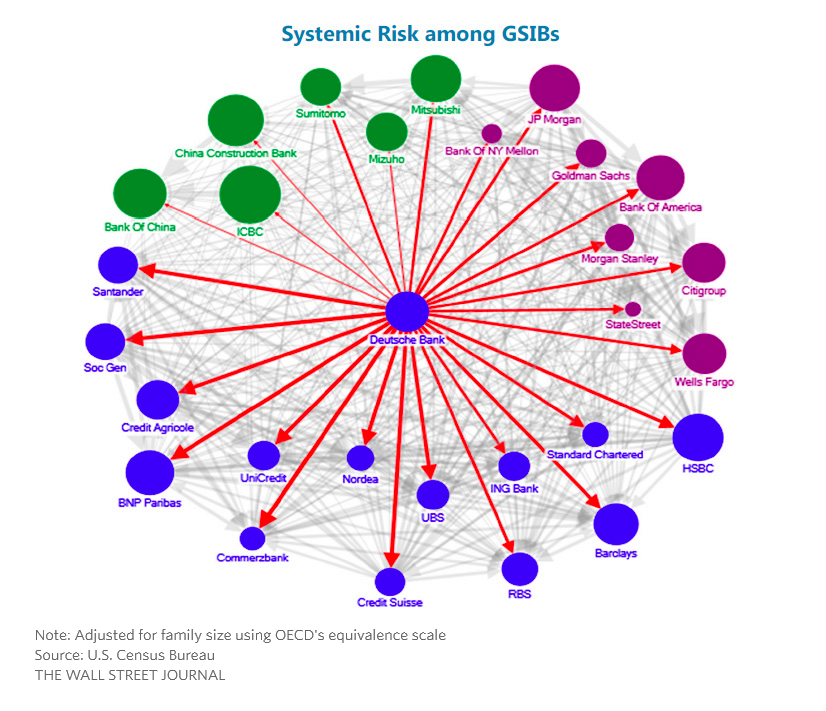
On June 29th, 2016 the IMF stated that “among the [globally systemically important banks], Deutsche Bank appears to be the most important net contributor to systemic risks, followed by HSBC and Credit Suisse,” reports The Wall Street Journal.

However, if you were to believe that statement, why should you be concerned about a German bank and how it will affect you while living in the U.S.? The IMF adds: “In particular, Germany, France, the U.K. and the U.S. have the highest degree of outward spillovers as measured by the average percentage of capital loss of other banking systems due to banking sector shock in the source country,” reports Bloomberg. The chart below clearly shows the systemic risks emanating out of a Deutsche Bank (DBK) collapse.

db1

Two years in succession, the American unit of Deutsche Bank has failed the FED’s “stress test” which is what determines the ability of the bank to weather out yet another ‘financial crisis’.


Leverage of Lehman vs. Deutsche Bank:

In 2007, Lehman had a leverage (the ratio of total assets to shareholder’s equity) of 31:1.  At the time that Lehman filed for bankruptcy, it had $639 billion in assets and $619 billion in debt. Still, it caused a ‘systemic risk’ worldwide.

In comparison, DBK has a mind boggling leverage of 40x, according to Berenberg analyst, James Chappell. He stated, “facing an illiquid credit market limiting Deutsche Bank’s (DBK) ability to deliver and with core profitability impaired, it is hard to see how DBK can escape this vicious circle without raising more capital. The CEO has eschewed this route for now, in the hope that self-help can break this loop, but with risk being re-priced again it is hard to see DBK succeeding.”

Why Can’t the ECB save DBK in the similar fashion as how the FED saved the banks, in the US?

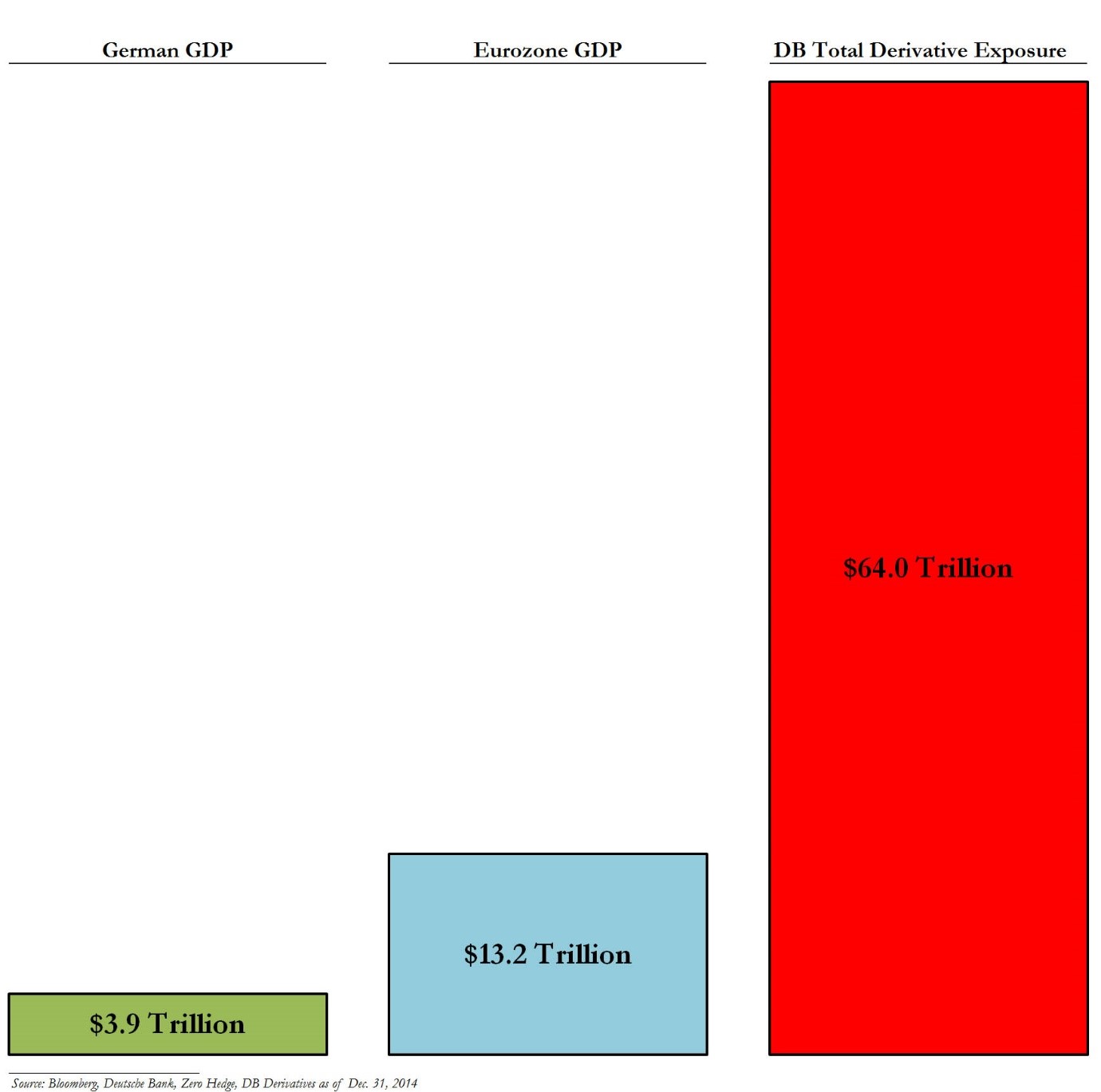
The nominal value of derivatives risk that DBK holds on its’ books is $72.8 trillion, according to the banks’ April 2016 earnings report. What is astounding about this, is that a single bank owns 13% of the total outstanding global derivatives, which was a staggering $550 trillion in 2015.

What is more concerning and alarming is that the market cap of DBK is less than $20 billion.

Nonetheless, the nominal value of derivatives exposure does not mean that DBK will have a default worth trillions of dollars seeing as most of the contracts are covered by counterparties. However, when the domino effect is put into motion, we have witnessed how it engulfs the entire world, into it.

If the domino effect does occur, Germany with its GDP of $4 trillion or the EU with a GDP of $18 trillion will not be in a position to gain control over it.

A nominal figure of the high derivatives risk on DBK, as of December 2014, is shown in the chart below.

db2


Negative interest regime is NOT the solution to global economic problems which we are facing today:

The European Central Banks’ NIRP policy is making matters worse for DBK, as the banks’ profits are getting squeezed thus making it difficult for it to repair its’ balance sheet.

The bank is finding it difficult to sell its’ assets because of illiquid credit markets. The banks’ management will also find it difficult to raise capital as the investment-banking industry is in a “structural decline”, according to Berenbergs’ James Chappell.


 BREXIT is adding to the woes:

DBK receives 19% of its’ revenues from the UK. After the “BREXIT” vote, the uncertainty regarding future relations of the U.K. with Europe has increased the risk for all of the banks. President Francois Hollande of France is eyeing the financial industry and is pitching for them to move to Paris from London.

DBK is the biggest European bank in London. Moving operations, which are handled by 8,000 members of the staff, will not be an easy task for DBK and will further weaken their balance sheet.


How is the stock behaving?

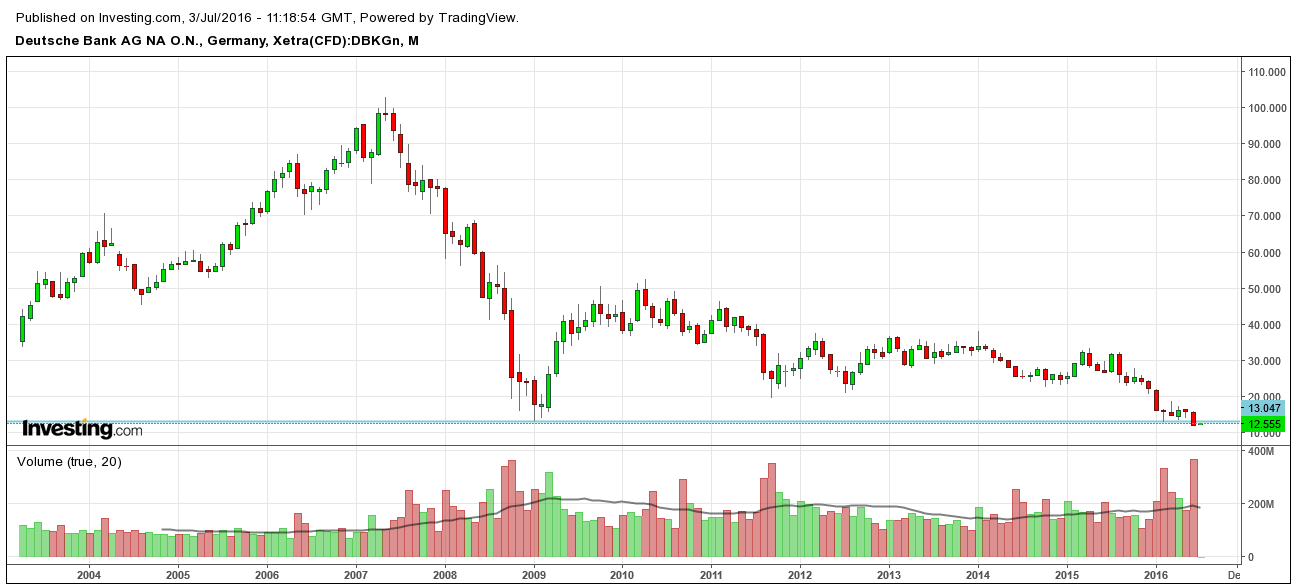
The stock is in a downtrend and has broken below the panic lows of 2009.

db3

The stock is quoting at a price to book ratio of 0.251, which indicates the pessimism of the markets towards the stock. The investors believe that the stock is not worth more than a quarter of its’ liquidation value.

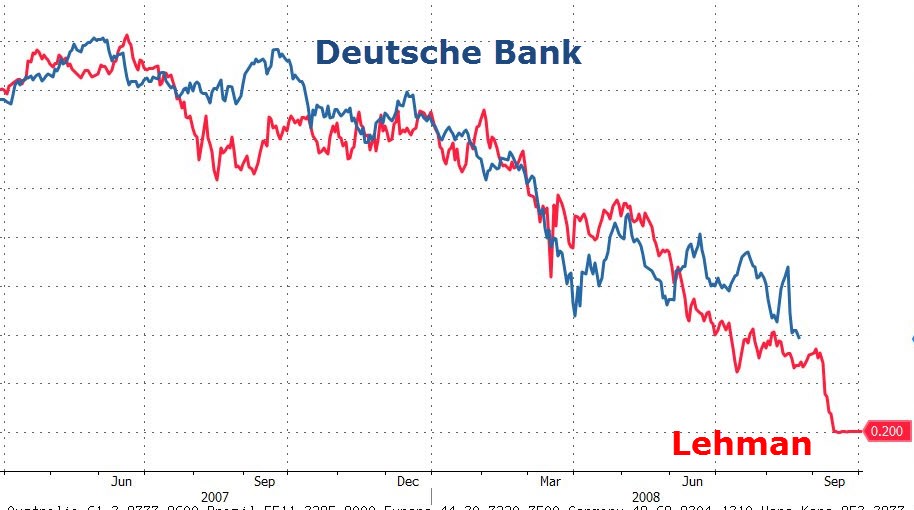
A comparative study of the stock, with Lehman, gives a more accurate picture of the future price of DBK, which is zero.

db4

The German Newspaper ‘Die Welt’ reported that the great George Soros had recently opened a short position of 0.51% of the DBK’s outstanding shares. This equates to 7 million shares, worth $7.5 billion, reports Investopedia.


 Conclusion:

The easy monetary policy of various Central Banks is the main reason for the banks holding such massive leverage. The “next financial crisis” will cause the Central Banks’ actions to be redundant and ineffective, as they will not be in a position to control this impending catastrophe! In such a situation, the world will revert to the only remaining resort left, and that is gold.

My readers have benefited immensely during the mini-crash post the ‘BREXIT’. Please continue to follow me so as you can protect yourself from the next “big one”, which will wipe out tens of trillions of dollars around the world.

Chris Vermeulen
TheGoldAndOilGuy.com

Did She Say QE 4?

0

I have no doubt that the implementation of QE 4 will be introduced into the stock markets.  I believe that the FED will commence injecting $50 billion to $100 billion per month into the markets. After seven years, this “short term” emergency measure has now resulted in a permanent fixture of the FEDs’ ‘NEW’ monetary policy.

There is a limit as to what monetary policies are capable of resolving. We must go back in time in order to realize that our problem is a ‘structural’ fiscal policy problem and it is only when we realize this that can we look towards the solutions, at hand.  Our current financial problems cannot be resolved by Central Banks.  These ‘accommodating’ monetary policies of Global Central Banks were never really necessary.  The global legislative governments needed to address these problems as far back as 2008.

“Black Friday” which occurred on June 24th, 2016 was just the beginning. Once again, Global Central Bankers will scurry to lower their interest rates! A recent article talked about how the market is reading all the data wrong.

The present ‘currency wars’ will continue to heat up more and more and consequently money printing will now escalate while the global debt will continue to rise exponentially. This is just the type of ‘crisis’ that will push gold prices even higher while investors seek out the most sought after ‘safe haven’ that has been in existence for well over 5,000 years.

Gold, will once again, as it did in 2008, offer the most security against stock market meltdowns and currency risks which surround us and have now become part of our daily economic fabric. I have been alerting my subscribers, since last year, of the fact that I was anticipating the timeliest entry point into this ‘asset class’.

It has become most obvious to me that Global Central Bankers have lost touch with ‘reality’ as they continue to lower interest rates and turn towards NIRP.


IS THIS THE POINT OF NO RETURN? 

The sole reason why the Global Central Bankers implemented ‘negative interest rates’ was to get money out of the banks and place it into the hands of consumers in hopes that they would spend more and therefore help to inflate the economy.  If this plan had been successful, consumers would have leveraged these low-interest rates into a positive rate of return.  However, this did not occur!

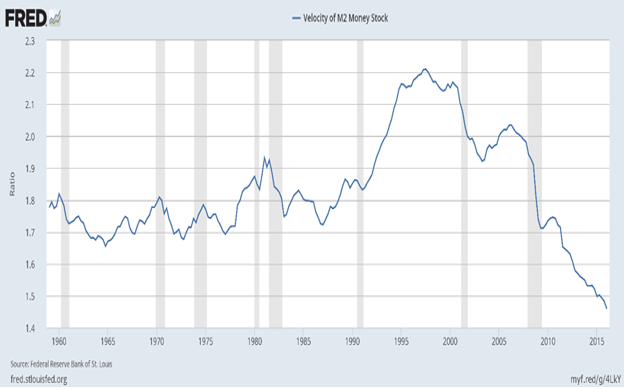
In general, ‘the velocity of money’ begins to increase after a successful ‘economic recovery. However, since 2007, the ‘velocity of money’, within the U.S., has been further ‘decreasing’ which implies that consumers have not been spending their money seeing as the “stimulus” money, which in fact, never reached them.

qe1


The basic idea was to have the banks directly provide consumers with money, which would, in turn, encourage and enable them to spend it. However, the money failed to reach the ‘working classes’. The FED created this “wealth effect” which resulted in the “artificial inflation” of stock prices.

The FED infused bank investment portfolios with cash rather than government securities. This cash was invested in the stock market rather than filtering down to “Main Street”.

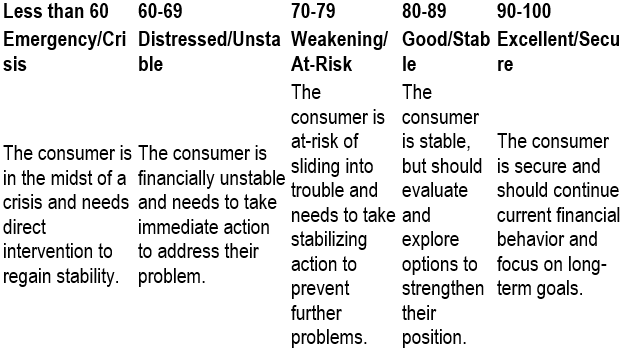
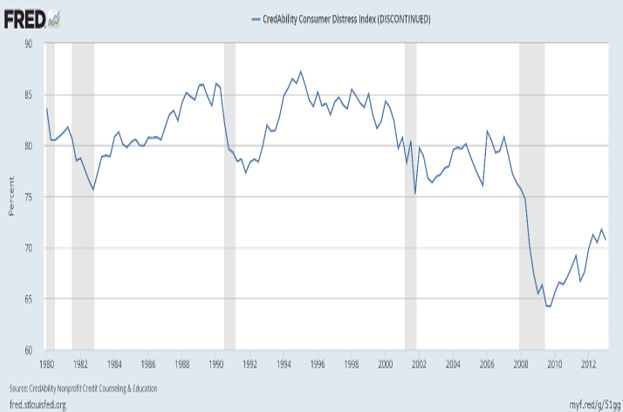
The “Consumer Distress Index”, Main Street, was a quarterly measure of the financial condition of the average American consumer. This was the first index to provide a comprehensive snapshot of the American consumers’ total financial picture, over time. While the index is no longer updated, recent data can still provide insight into the financial well-being of consumers. The index was based on a 100-point scale, as can be viewed in the chart below:


table


What you can extrapolate, from the below chart, is that the consumer is ‘financially unstable’ and needs to take immediate action in order to address their ‘financial problems’.  As of today, the consumer is in the midst of a “financial crisis” and is in need of direct intervention so as to regain ANY “financial stability”.

qe2

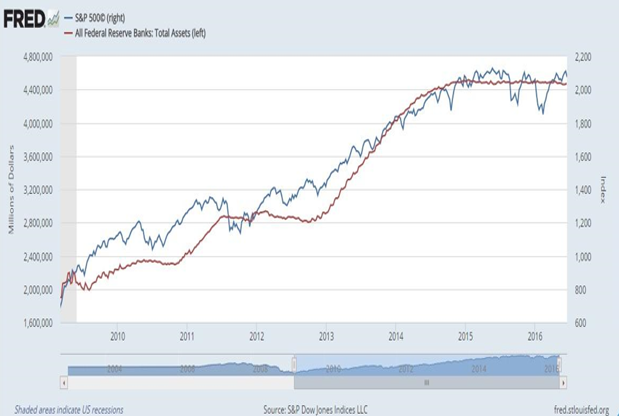
The following chart below displays where all of the “Quantitative Easing” money was distributed.  The “Quantitative Easing” (QE) money was used to artificially “inflate” stock market prices. The FED was caught up in its’ own wrong doings.  Each and every time that the stock market showed signs of weakness, the FED would step in to support prices by announcing the implementation of more QE.  As you can see, very clearly, in the below chart, there is a positive correlation between QE and the rise in the SPX!

qe3


Concluding Thoughts:

In short, the recent price action of the US stock market, economic data, and Brexit results clearing indicate tough times ahead. What will the FED do? No doubt they will try to implement some new form of QE which will try to hold the stock market up and funnel through in the hands of the already wealthy. It seems that is all they are good at doing really.

But will the FED be able to save the market this time? I think not because for the first time in 7 years the data is showing similar and in many cases much worse data than we say in 2001 and 2008.

The good news is that we can not only avoid losing money buy actually become the wealthiest we have ever been if/when the next bear market happens and I tell my readers exactly how we will do that. The reality is, it does not matter when the next bear market takes place whether it is 2016- 2018, or beyond, the key is that we know how and when to get positioned for these life changing moves as the market unfolds.

Follow My Work Free at: www.TheGoldAndOilGuy.com

By Chris Vermeulen

http://www.thegoldandoilguy.com/say-qe-4/