Home Blog Page 205

Live Faster! Spend More!

0

THERE’s nothing much I can say that hasn’t already been said about the Bank of England’s decision to cut the bank rate to a 322-year low of 0.25%,writes Dan Denning at Capital & Conflict.

Full Article: Live Faster! Spend More!

Disclaimer© 2010 Junior Gold ReportJunior Gold Report’ Newsletter: Junior Gold Report’s Newsletter is published as a copyright publication of Junior Gold Report (JGR). No Guarantee as to Content: Although JGR attempts to research thoroughly and present information based on sources we believe to be reliable, there are no guarantees as to the accuracy or completeness of the information contained herein. Any statements expressed are subject to change without notice. JGR, its associates, authors, and affiliates are not responsible for errors or omissions. Consideration for Services: JGR, it’s editor, affiliates, associates, partners, family members, or contractors may have an interest or position in featured, written-up companies, as well as sponsored companies which compensate JGR. JGR has been paid by the company written up. Thus, multiple conflicts of interests exist. Therefore, information provided herewithin should not be construed as a financial analysis but rather as an advertisement. The author’s views and opinions regarding the companies featured in reports are his own views and are based on information that he has researched independently and has received, which the author assumes to be reliable. No Offer to Sell Securities: JGR is not a registered investment advisor. JGR is intended for informational, educational and research purposes only. It is not to be considered as investment advice. Subscribers are encouraged to conduct their own research and due diligence, and consult with their own independent financial and tax advisors with respect to any investment opportunity. No statement or expression of any opinions contained in this report constitutes an offer to buy or sell the shares of the companies mentioned herein. Links: JGR may contain links to related websites for stock quotes, charts, etc. JGR is not responsible for the content of or the privacy practices of these sites. Release of Liability: By reading JGR, you agree to hold Junior Gold Report its associates, sponsors, affiliates, and partners harmless and to completely release them from any and all liabilities due to any and all losses, damages, or injuries (financial or otherwise) that may be incurred.

Forward Looking Statements
Except for statements of historical fact, certain information contained herein constitutes forward-looking statements. Forward looking statements are usually identified by our use of certain terminology, including “will”, “believes”, “may”, “expects”, “should”, “seeks”, “anticipates”, “has potential to”, or “intends’ or by discussions of strategy, forward looking numbers or intentions. Such forward-looking statements involve known and unknown risks, uncertainties and other factors which may cause our actual results or achievements to be materially different from any future results or achievements expressed or implied by such forward-looking statements. Forward-looking statements are statements that are not historical facts, and include but are not limited to, estimates and their underlying assumptions; statements regarding plans, objectives and expectations with respect to the effectiveness of the Company’s business model; future operations, products and services; the impact of regulatory initiatives on the Company’s operations; the size of and opportunities related to the market for the Company’s products; general industry and macroeconomic growth rates; expectations related to possible joint and/or strategic ventures and statements regarding future performance. Junior Gold Report does not take responsibility for accuracy of forward looking statements and advises the reader to perform own due diligence on forward looking numbers or statements.


The Gold Update by Mark Mead Baillie

0

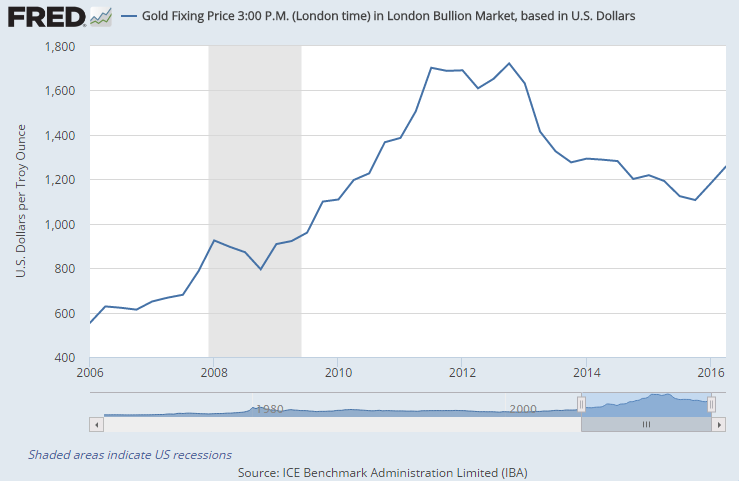
If the final trading day for 2016 had been yesterday (Friday), Gold having settled at 1324 would be (as presently ’tis) a gain of 24.8% for the year, the fifth best annual performance of the last four decades. Yet with over four months still to run in 2016, extrapolate that pace to year’s end and we’d find Gold settling this full year at 1463 for a 37.9% annual gain, its best since 1979.

Full Article The Gold Update by Mark Mead Baillie 

Disclaimer© 2010 Junior Gold ReportJunior Gold Report’ Newsletter: Junior Gold Report’s Newsletter is published as a copyright publication of Junior Gold Report (JGR). No Guarantee as to Content: Although JGR attempts to research thoroughly and present information based on sources we believe to be reliable, there are no guarantees as to the accuracy or completeness of the information contained herein. Any statements expressed are subject to change without notice. JGR, its associates, authors, and affiliates are not responsible for errors or omissions. Consideration for Services: JGR, it’s editor, affiliates, associates, partners, family members, or contractors may have an interest or position in featured, written-up companies, as well as sponsored companies which compensate JGR. JGR has been paid by the company written up. Thus, multiple conflicts of interests exist. Therefore, information provided herewithin should not be construed as a financial analysis but rather as an advertisement. The author’s views and opinions regarding the companies featured in reports are his own views and are based on information that he has researched independently and has received, which the author assumes to be reliable. No Offer to Sell Securities: JGR is not a registered investment advisor. JGR is intended for informational, educational and research purposes only. It is not to be considered as investment advice. Subscribers are encouraged to conduct their own research and due diligence, and consult with their own independent financial and tax advisors with respect to any investment opportunity. No statement or expression of any opinions contained in this report constitutes an offer to buy or sell the shares of the companies mentioned herein. Links: JGR may contain links to related websites for stock quotes, charts, etc. JGR is not responsible for the content of or the privacy practices of these sites. Release of Liability: By reading JGR, you agree to hold Junior Gold Report its associates, sponsors, affiliates, and partners harmless and to completely release them from any and all liabilities due to any and all losses, damages, or injuries (financial or otherwise) that may be incurred.

Forward Looking Statements
Except for statements of historical fact, certain information contained herein constitutes forward-looking statements. Forward looking statements are usually identified by our use of certain terminology, including “will”, “believes”, “may”, “expects”, “should”, “seeks”, “anticipates”, “has potential to”, or “intends’ or by discussions of strategy, forward looking numbers or intentions. Such forward-looking statements involve known and unknown risks, uncertainties and other factors which may cause our actual results or achievements to be materially different from any future results or achievements expressed or implied by such forward-looking statements. Forward-looking statements are statements that are not historical facts, and include but are not limited to, estimates and their underlying assumptions; statements regarding plans, objectives and expectations with respect to the effectiveness of the Company’s business model; future operations, products and services; the impact of regulatory initiatives on the Company’s operations; the size of and opportunities related to the market for the Company’s products; general industry and macroeconomic growth rates; expectations related to possible joint and/or strategic ventures and statements regarding future performance. Junior Gold Report does not take responsibility for accuracy of forward looking statements and advises the reader to perform own due diligence on forward looking numbers or statements.

Is Gold At A Tipping Point? 2 Scenarios For Traders Now

0

By Kira Brecht

(Kitco News) – As traders return to work Monday morning, gold prices have already edged off their overnight lows. Gold buyers are nibbling as the yellow metal drops to test the lower boundary of its two-month trading range.

The news: Fed Chair Janet Yellen’s speech last week triggered renewed speculation that the central bank may raise rates sooner rather than later.

Is it another case of the boy who cried wolf? The renewed hoopla over September being a “live” Fed meeting may well be another case of the boy who cried wolf.

If the Fed is going to raise rates in September, somebody forget to tell the US 10-year note: the yield remains in the same sleepy range between 1.63% and 1.45% that have confined the market since mid-July. The CME’s Fed Watch tool reveals that Fed fund futures are pricing in a 30% probability at the September 21 Federal Open Market Committee meeting.

Even if the Fed does pull the trigger on a .25 basis point rate hike, the official interest rate remains well below historical norms. The federal funds rate stands a 0.25-0.50%. A small blip higher of 0.25% would not mean much in real economic terms, and it would still remain below 1.00%.

Technically Speaking
Gold buyers are supporting the range bottom. Let’s take a look at Figure 1 below. Since late June, Comex December gold futures have shifted into a neutral sideways range bordered by support at $1.314.80 and resistance at $1.384.40.

A potential triangle formation has been developing on the daily chart (seen in red), but gold prices have marginally breached the lower trend line. Significantly, the gold contract, has held above the $1,314.80 range bottom.

Did Janet Trigger Another Buy Spot In Gold?
The burden remains on the bulls to continue to defend retreats to the lower boundary of the two-month range.

Scenario A: If support at the range bottom at $1,314.80 cracks –this would be a bearish short-term signal. The 100-day moving average, shown in blue, stands as next support and a bearish target on a range breakdown at $1,301.70.

Scenario B: If support at the range bottom at $1,314.80 holds firm –this would be a bullish short-term signal. The 20-day moving average, shown in black, stands as a nearby bullish target at $1,346.60.

Gold bulls face some headwinds this week with the strength in the U.S. dollar index and a spate of key U.S. economic reports. Traders will look to Thursday’s ISM release and Friday’s employment report as potential indicators on whether the Fed will hike at its September meeting.

Trading plan: Watch the price chart. Define your trading levels, your price objectives and your stop-loss points. Plan your trade and trade your plan. Gold trade could become volatile this week.

Disclaimer© 2010 Junior Gold ReportJunior Gold Report’ Newsletter: Junior Gold Report’s Newsletter is published as a copyright publication of Junior Gold Report (JGR). No Guarantee as to Content: Although JGR attempts to research thoroughly and present information based on sources we believe to be reliable, there are no guarantees as to the accuracy or completeness of the information contained herein. Any statements expressed are subject to change without notice. JGR, its associates, authors, and affiliates are not responsible for errors or omissions. Consideration for Services: JGR, it’s editor, affiliates, associates, partners, family members, or contractors may have an interest or position in featured, written-up companies, as well as sponsored companies which compensate JGR. JGR has been paid by the company written up. Thus, multiple conflicts of interests exist. Therefore, information provided herewithin should not be construed as a financial analysis but rather as an advertisement. The author’s views and opinions regarding the companies featured in reports are his own views and are based on information that he has researched independently and has received, which the author assumes to be reliable. No Offer to Sell Securities: JGR is not a registered investment advisor. JGR is intended for informational, educational and research purposes only. It is not to be considered as investment advice. Subscribers are encouraged to conduct their own research and due diligence, and consult with their own independent financial and tax advisors with respect to any investment opportunity. No statement or expression of any opinions contained in this report constitutes an offer to buy or sell the shares of the companies mentioned herein. Links: JGR may contain links to related websites for stock quotes, charts, etc. JGR is not responsible for the content of or the privacy practices of these sites. Release of Liability: By reading JGR, you agree to hold Junior Gold Report its associates, sponsors, affiliates, and partners harmless and to completely release them from any and all liabilities due to any and all losses, damages, or injuries (financial or otherwise) that may be incurred.

Forward Looking Statements
Except for statements of historical fact, certain information contained herein constitutes forward-looking statements. Forward looking statements are usually identified by our use of certain terminology, including “will”, “believes”, “may”, “expects”, “should”, “seeks”, “anticipates”, “has potential to”, or “intends’ or by discussions of strategy, forward looking numbers or intentions. Such forward-looking statements involve known and unknown risks, uncertainties and other factors which may cause our actual results or achievements to be materially different from any future results or achievements expressed or implied by such forward-looking statements. Forward-looking statements are statements that are not historical facts, and include but are not limited to, estimates and their underlying assumptions; statements regarding plans, objectives and expectations with respect to the effectiveness of the Company’s business model; future operations, products and services; the impact of regulatory initiatives on the Company’s operations; the size of and opportunities related to the market for the Company’s products; general industry and macroeconomic growth rates; expectations related to possible joint and/or strategic ventures and statements regarding future performance. Junior Gold Report does not take responsibility for accuracy of forward looking statements and advises the reader to perform own due diligence on forward looking numbers or statements.

Can Stocks Survive Without Stimulus?

0

A fiery debate rages among investors over the question of central bank stimulus.  The question is whether the stock market needs stimulus in order to advance, and is stimulus only creating a bubble which will burst at some point and lead to depression?

Regardless of the philosophical rectitude of central bank intervention, there can be no denying its efficacy.  The most fundamental truth of the financial market is that “liquidity, liquidity, liquidity” is the market’s lifeblood.   Financial stimulus contains the seeds of recovery and will cure any bear market in equities, as I’ll attempt to prove in this commentary.  The truth of this assertion can be found in the very wisdom of King Solomon, who in the book of Ecclesiastes wrote that “money answers all things.”  Stocks will always, without exception, respond positively to stimulus – provide there are no countervailing obstacles in the way [e.g. tax increases, margin requirements].

Critics of stimulus often point to Japan as an example of how quantitative easing (QE) supposedly failed.  Seventeen years ago the Bank of Japan (BOJ) led all other central banks by more than a decade with its zero-interest-rate policy, when its benchmark rate was lowered to zero for the first time during March 1999.  As Dr. Ed Yardeni recently observed:

“The BOJ lagged behind the ECB by nearly 20 months, introducing its negative-interest-rate policy (NIRP) on January 29 of this year.  The central bank was early with QE when it expanded its reserves balance starting during November 2001 through January 2006.  That was just a warm-up act for the dramatic expansion of these reserves that started in early 2011, and then went vertical since late 2012.”

While Japan’s economic troubles remain, is it fair to assume that the BOJ’s attempts at stimulus were an abysmal failure?  Let’s examine the evidence.

Following is a long-term graph of Japan’s Nikkei stock index.  Japan’s attempts at QE started in late 2001 and ended in 2006.  Given the downside momentum that had been established in the Nikkei heading into 2001 – 11 years worth to be exact – it took some time before the first effects of the stimulus registered in the stock market.  By 2003, however, the Nikkei was on the up-and-up.  Japan’s central bank let their foot off the QE accelerator between 2006 and 2001, though, and this explains why the rally didn’t continue further.  The 2008 credit crisis only added to the Nikkei’s woes.

nikkei

Then starting in 2011, the BOJ once again commenced QE at an even more furious pace than before.  This led to a much quicker improvement in the Nikkei, which zoomed to its highest level in over a decade.  Undoubtedly, Japan’s second attempt at QE would have been far more successful had not the government implemented an ill-advised tax increase.  This foolish measure heavily undermined the positive impact of QE and put the brakes on the Nikkei rally.  It also put Japan’s economy back into recession for a time.

A lingering problem for the European Union countries since 2008 has been the negative impact of years of misguided austerity policies.  European Central Bank (ECB) President Mario Draghi famously pledged years ago the ECB would do “whatever it takes” to reverse the deflationary undercurrents plaguing the euro zone.  But until this year the ECB failed to live up to that promise.  Late last year Europe’s central bank finally got serious and lowered deposit rates while extending its 80-billion-euro monthly asset purchase program.

Positive results of the bank’s efforts to date haven’t yet been seen, though there are preliminary indications that many European bourses are establishing intermediate-term bottoms.  Much depends on the ECB’s commitment to QE in the year ahead.  By keeping the proverbial pedal to the floor for an extended length of time, the ECB may yet succeed in reversing the continent’s financial malaise.  However, if the bank makes the mistake Japan made by easing up on QE prematurely, the euro zone can expect to see a resumption of the economic malaise.

By far the biggest success story of QE has been the U.S.  The Fed’s unprecedented stimulus measures in the wake of the 2008 credit crash galvanized an historic rally in the stock market which brought recovery to the major indices in record time.  Since the U.S. essentially has a financial economy, any sustained recovery in financial asset prices must of necessity lift the economy sooner or later.  Thus the improvement in many sectors of the economy since 2009 can be attributed, at least in part, to QE.

The evidence to date strongly suggests that stimulus played an integral role in fueling the mighty asset price recovery that began over seven years ago.  The Federal Reserve’s interventionary QE program was successful beyond anyone’s wildest guess when measured by the result of the equity and real estate markets.  And while many are quick to condemn QE as having been a failure at resuscitating the economy, the data would argue otherwise.

But after about six years of easy money, the Fed brought its QE program to a close in late 2014.  After that the stock market as measured by the NYSE Composite Index (NYA), the broadest measure of U.S. equities, entered a prolonged sideways trend, which can largely be attributed to the loss of QE.  The loss of billions of dollars per month of liquidity for stocks was gone and with it the sustained forward momentum that fueled the market’s surge from 2009 to 2014.

nya

Keeping the U.S. market buoyant since then has been a combination of factors.  Continued low interest rates coupled with huge inflows of cash from foreigners seeking a safe haven from the global crisis have been a huge benefit for equities.  The lack of competition from commodities and other assets has also helped.  This influx of foreign “hot” money has amounted to a de facto stimulus for stocks, so in essence the market is still receiving stimulus from afar.

Stocks need stimulus in order to advance in the absence of a strong economy.  When the economy is strong investors need no prodding to put their excess earnings into equities with hopes of greater profits.  A strong economy also breeds confidence in the present and optimism about the future; it serves as a kind of natural stimulus for the stock market.

Ironically, central bank stimulus can also serve as a deterrent for small investors since they interpret the need for stimulus as confirmation that the economy is weak and needs assistance.  Thus the public sometimes lack the incentive to take risks when QE is in full swing.  It’s the professional investor who is sophisticated enough to read between the lines and buy stocks in a weak economy, provided there is stimulus.  This is the great paradox of a stimulus-driven bull market: only the few participate, yet it eventually benefits the many as the wealth generated from higher stock prices permeates the broad economy.

The great unknown factor concerning QE is the outer limit of its success.  Just how successful can QE be in stimulating the economy?  A satisfactory answer to this question hasn’t yet been supplied.  Just when it looked like the financial market rebound from the 2009 low was ready to explode into a full-fledged runaway bull, the Fed took its foot off the accelerator.  Eventually the generous liquidity the Fed was supplying ground to a halt and the stock market responded accordingly as its forward momentum slowed exceedingly.

Central bankers, it seems, have an inveterate fear of inflation.  Most of today’s voting Fed members came of age during the runaway inflation of the 1970s.  The memories of that harrowing experience continue to haunt them, and its influence is reflected in their policies.  The prevailing belief is that too much QE equates to too much inflation.  This is a fallacy.  The U.S. and global economies have been so significantly altered by demographic, social and political shifts in the last two decades that inflation won’t be a major concern for many years to come.

The Fed could have doubled its asset purchases between 2009 and 2014 without creating any appreciable increase in inflation.  Instead it decided to stop QE before inflation even registered, which was tantamount to pushing a stalled vehicle up a hill only to stop pushing before the summit is reached.  It would have been exciting to see just how successful QE could have been had the Fed decided to gun for prosperity.  Instead, the Fed chickened out and ruined its best chance at delineating once and for all the outer limits of central bank stimulus.

The other objection to a full-throttle QE initiative is the widespread fear of creating another asset bubble similar to the real estate bubble that popped in 2006 and led to the credit crisis.  History and human nature testify that a catastrophic crash of the magnitude of the ’08 credit storm takes at least one entire generation (i.e. circa 20 years) to dissipate.  In other words, it takes the advent of an entirely new generation who didn’t experience the crisis to repeat its mistakes.  At present there is a complete absence of risk-taking behavior among the generation that experienced 2008.  That deep-seated fear of risk won’t disappear anytime soon.  Thus the “bubble that broke the world” isn’t going to happen again for a long, long time.

The simple answer to the question, “Can stocks survive without stimulus?” is an emphatic “No!”  Stocks always need fresh injections of liquidity to gain ground and surge ahead.  Whether the stimulus takes the form of QE, fiscal policy or surplus savings is a moot point.  But stimulus in all its many forms must be present to propel equity prices ever higher.  And rising stock prices in a financial economy like the U.S. always creates a wealth effect.  Thus in the final analysis, stimulus is to everyone’s benefit.

The Stock Market Cycles

For the summer months only, the book “The Stock Market Cycles” is available at a special discount to readers of this commentary.  The book reveals the key to interpreting long-term stock price movement and economic performance, namely the famous Kress series of yearly cycles. This work was undertaken based on popular demand and was written in a style that casual readers and experts alike can enjoy and understand. The book covers each one of the yearly cycles in the Kress Cycle series, starting with the 2-year cycle and ending with the 120-year Grand Super Cycle.

The book also covers the K Wave and the effects of long-term inflation/deflation that these cycles exert over stock prices and the economy. Each chapter contains illustrations that show exactly how the yearly cycles influenced stock market performance and explains where the peaks and troughs of each cycle are located and how the cycles can predict future market and economic performance.  Order your autographed copy today:

http://www.clifdroke.com/books/Stock_Market.html

Clif Droke is a recognized authority on moving averages and internal momentum. He is the editor of the Momentum Strategies Report newsletter, published since 1997.  He has also authored numerous books covering the fields of economics and financial market analysis.  His latest book is Mastering Moving Averages. For more information visit www.clifdroke.com

Disclaimer© 2010 Junior Gold ReportJunior Gold Report’ Newsletter: Junior Gold Report’s Newsletter is published as a copyright publication of Junior Gold Report (JGR). No Guarantee as to Content: Although JGR attempts to research thoroughly and present information based on sources we believe to be reliable, there are no guarantees as to the accuracy or completeness of the information contained herein. Any statements expressed are subject to change without notice. JGR, its associates, authors, and affiliates are not responsible for errors or omissions. Consideration for Services: JGR, it’s editor, affiliates, associates, partners, family members, or contractors may have an interest or position in featured, written-up companies, as well as sponsored companies which compensate JGR. JGR has been paid by the company written up. Thus, multiple conflicts of interests exist. Therefore, information provided herewithin should not be construed as a financial analysis but rather as an advertisement. The author’s views and opinions regarding the companies featured in reports are his own views and are based on information that he has researched independently and has received, which the author assumes to be reliable. No Offer to Sell Securities: JGR is not a registered investment advisor. JGR is intended for informational, educational and research purposes only. It is not to be considered as investment advice. Subscribers are encouraged to conduct their own research and due diligence, and consult with their own independent financial and tax advisors with respect to any investment opportunity. No statement or expression of any opinions contained in this report constitutes an offer to buy or sell the shares of the companies mentioned herein. Links: JGR may contain links to related websites for stock quotes, charts, etc. JGR is not responsible for the content of or the privacy practices of these sites. Release of Liability: By reading JGR, you agree to hold Junior Gold Report its associates, sponsors, affiliates, and partners harmless and to completely release them from any and all liabilities due to any and all losses, damages, or injuries (financial or otherwise) that may be incurred.

Forward Looking Statements
Except for statements of historical fact, certain information contained herein constitutes forward-looking statements. Forward looking statements are usually identified by our use of certain terminology, including “will”, “believes”, “may”, “expects”, “should”, “seeks”, “anticipates”, “has potential to”, or “intends’ or by discussions of strategy, forward looking numbers or intentions. Such forward-looking statements involve known and unknown risks, uncertainties and other factors which may cause our actual results or achievements to be materially different from any future results or achievements expressed or implied by such forward-looking statements. Forward-looking statements are statements that are not historical facts, and include but are not limited to, estimates and their underlying assumptions; statements regarding plans, objectives and expectations with respect to the effectiveness of the Company’s business model; future operations, products and services; the impact of regulatory initiatives on the Company’s operations; the size of and opportunities related to the market for the Company’s products; general industry and macroeconomic growth rates; expectations related to possible joint and/or strategic ventures and statements regarding future performance. Junior Gold Report does not take responsibility for accuracy of forward looking statements and advises the reader to perform own due diligence on forward looking numbers or statements.
STOCK MARKET IS CRAZY AND CRAZY MEANS OPPORTUNITY

0

The SPX has completed its’ “Broadening Topping Pattern”
…the next trend is DOWNWARDS!

The current pattern is suggesting that a significant top is at hand. I fully believe both in patterns and indicators and right now the current pattern is suggesting that a significant top is at hand.

My cycles are suggesting a potential “Black Swan” event, in multiple indexes, which are “imminent”.  The SPX may have made its’ last challenge of the upper trend line of its’ ‘Broadening Top’. On Friday, August 19th, 2016, it closed beneath its’ ‘Cycle Top’ resistance at 2185.38.  The SPX has fulfilled all of the fractal requirements necessary for a completed “corrective” uptrend. The uptrend from 1810 has been in a “corrective phase”. The next wave down will be an impulsive wave.

The large divergences which I have been viewing, in my proprietary oscillators, are most real and accurate and once the selling begins, the momentum should quickly move to the downside.  The current market is being supported by a lack of sellers, more so than aggressive buying.  With investors still thinking that there is nowhere else to place their money, they appear to be content with leaving their money at “risk on” assets, within a market that is pushing all-time highs.  This type of “mentality” usually leads to large losses, rather than big gains.  There is just no opportunity for growth in the SPX!

Investors have become complacent with the current rally.  They listen to and believe what the FED has been saying regarding interest rates and they have come to believe that everything about this market depends upon the FED. I do not believe that to be the case.  I believe that the FED is or should I say will be irrelevant in due time!

The Bank of America Merrill Lynch reports that its’ clients (institutions, hedge funds and private clients) who have sold stock for all but 2 to 3 weeks, during all of 2016, have once again sold $1.9 billion of US stocks while the SPX was hitting new highs.  Institutional clients led the sales due to poor performance.  It has been the retail investors that have been flooding into the market while anticipating a massive breakout and rally.

The big and smart money continues to build up massive short positions. George Soros has become more bearish on equity markets, nearly doubling his short bet against the SPX, following similar moves by Jeffrey Gundlach, Carl Icahn and David Tepper. According to his 13F filing, Soros now owns roughly 4 million ‘put options’ on shares of the SPY.

We are presently living on borrowed time and vast amounts of borrowed moneys. This is a period of time of “unprecedented economic upheaval” which was caused by ‘financial engineering’ by governments and their Central Banks. It’s a slow-motion catastrophe, where as we are living today at the expense of tomorrow. The FEDs’ balance sheet has more than quadrupled since the Crash of 2008.  This is unprecedented:

Keep in mind, that most of these highly successful investors mentioned above also predicted other major market moves if you look back through the years. Their huge bets and called typically play out, but I do find most of them jump the gun a little early (many months in most cases). Reason being, they understand how and why the markets move, and because they do, they know when various markets are nearing a major turning point.

The catch, with trying to time these major multiyear market reversals is that all investors around the world (all market participants) buying/selling habits need to stall out and reverse direction for the new trend to take hold. This always seems to take longer than we expect, but these highly successful investors along with myself feel this bull market in stocks is about to come to an end.

Conclusion:

The next stage will become a vicious deflationary cycle in which prices and growth “crash and burn”. Prepare for another massive wave poor earnings, job layoffs, and falling stock prices.

Over the past 500 years, or more, whenever deflation emerged, price of gold gained and always gained big, in terms of purchasing power and I don’t feel this time will be any different.

There will be many ways to profit from all of this, precious metals is just one of many awesome opportunities unfolding for myself and subscribers to enjoy.

My ETF Trades: www.TheGoldAndOilGuy.com

Chris Vermeulen

Disclaimer© 2010 Junior Gold ReportJunior Gold Report’ Newsletter: Junior Gold Report’s Newsletter is published as a copyright publication of Junior Gold Report (JGR). No Guarantee as to Content: Although JGR attempts to research thoroughly and present information based on sources we believe to be reliable, there are no guarantees as to the accuracy or completeness of the information contained herein. Any statements expressed are subject to change without notice. JGR, its associates, authors, and affiliates are not responsible for errors or omissions. Consideration for Services: JGR, it’s editor, affiliates, associates, partners, family members, or contractors may have an interest or position in featured, written-up companies, as well as sponsored companies which compensate JGR. JGR has been paid by the company written up. Thus, multiple conflicts of interests exist. Therefore, information provided herewithin should not be construed as a financial analysis but rather as an advertisement. The author’s views and opinions regarding the companies featured in reports are his own views and are based on information that he has researched independently and has received, which the author assumes to be reliable. No Offer to Sell Securities: JGR is not a registered investment advisor. JGR is intended for informational, educational and research purposes only. It is not to be considered as investment advice. Subscribers are encouraged to conduct their own research and due diligence, and consult with their own independent financial and tax advisors with respect to any investment opportunity. No statement or expression of any opinions contained in this report constitutes an offer to buy or sell the shares of the companies mentioned herein. Links: JGR may contain links to related websites for stock quotes, charts, etc. JGR is not responsible for the content of or the privacy practices of these sites. Release of Liability: By reading JGR, you agree to hold Junior Gold Report its associates, sponsors, affiliates, and partners harmless and to completely release them from any and all liabilities due to any and all losses, damages, or injuries (financial or otherwise) that may be incurred.

Forward Looking Statements
Except for statements of historical fact, certain information contained herein constitutes forward-looking statements. Forward looking statements are usually identified by our use of certain terminology, including “will”, “believes”, “may”, “expects”, “should”, “seeks”, “anticipates”, “has potential to”, or “intends’ or by discussions of strategy, forward looking numbers or intentions. Such forward-looking statements involve known and unknown risks, uncertainties and other factors which may cause our actual results or achievements to be materially different from any future results or achievements expressed or implied by such forward-looking statements. Forward-looking statements are statements that are not historical facts, and include but are not limited to, estimates and their underlying assumptions; statements regarding plans, objectives and expectations with respect to the effectiveness of the Company’s business model; future operations, products and services; the impact of regulatory initiatives on the Company’s operations; the size of and opportunities related to the market for the Company’s products; general industry and macroeconomic growth rates; expectations related to possible joint and/or strategic ventures and statements regarding future performance. Junior Gold Report does not take responsibility for accuracy of forward looking statements and advises the reader to perform own due diligence on forward looking numbers or statements.

Final Catastrophe of the Currency System

0

The fate of the global economy was decided decades ago as deficits, debts and derivatives started their exponential growth and reached the time bomb phase that we are now in. This final chapter of this 100-year era will end in “a final and total catastrophe of the currency system” as von Mises succinctly articulated.

It started on Jekyll Island

Screen-Shot-2016-08-25-at-10.12.56

It all started in 1910 when a few senators and bankers, led by JP Morgan, secretly met on Jekyll Island with the purpose to set up the Federal Reserve and so control the banking system. Thus, the Fed was a creation by private bankers and for the benefit of these bankers. Few of them could have imagined the enormous success of their venture as the control of the financial system led to vast fortunes for a very small elite. The back side of these fortunes is global debt of $230 trillion plus unfunded liabilities and derivatives. The total which is in the quadrillions is what the poor masses in the world are liable for. Not that they will ever be able to repay it but the implosion of these debts will lead to misery for the majority of people for generations to come.

Critical to protect yourself against these events

Sadly, things have now gone too far to stop the inevitable currency collapse and implosion of the financial system but that doesn’t mean that it is too late for individuals to protect themselves. As we enter this final phase, there will be panic in financial markets with governments and central banks taking draconian measures. Below are some of the potential risks that all investors must protect themselves against today:

  • Currency collapse –  leading to destruction of capital
  • Capital controls – making it impossible to take money out of bank or country
  • Bail-ins the bank will steal your money in order to try to save itself
  • Forced investments – compulsory purchase of treasuries with your bank or pension assets
  • Custodial risk –  stocks and bonds will be hypothecated by the bank, leaving you nothing
  • Bank failures – all your investments will disappear as the bank becomes insolvent

The above list in not exhaustive but it contains the most likely events that will take place in the next few years. Most private investors don’t see these risks and have zero protection against them. And professional money managers haven’t got a clue about real risk, nor do they see any need for protection or insurance. When you manage OPM (Other People’s Money), you take maximum risk in order to benefit from the upside. The downside is not your risk and thus it can be ignored. This strategy works extremely well until the music stops. But as long as money printing and credit creation inflates markets, these professionals will never spend a second worrying about the total destruction of clients’ money.

So how likely are the above risks and how do you protect against them? Anyone who has followed some of my work will know that I consider all the above risks as guaranteed to materialise.

Screen-Shot-2016-08-25-at-10.56.32

Currency collapse is already happening with all currencies down 97-99% in the last 100 years. The final 1-3% will happen in the next few years as governments print unlimited amounts of money. But remember that the last 1-3% fall is 100% from here and thus a total destruction of money. So whatever cash you have will be totally worthless in the coming hyperinflationary phase.

Capital controls are likely to start within 12-18 months in many countries including the US. As deficits increase and currencies fall, governments will stop anyone from taking money out of the bank as well as out of the country. This is just the next step in the total control money. We have lately seen FATCA (Foreign Account Tax Compliance), cash bans and the OECD AEOI (Automatic Exchange of bank Information). Capital controls will be the next logical step in an attempt to virtually confiscate money. Governments on the road to bankruptcy will take any desperate measure to control the people and their money.

Screen-Shot-2016-08-25-at-11.10.40

Bail-ins are guaranteed and in the legislation of most Western Countries. The average person has no idea what bail-in is nor its consequences. Simply, it means that for insolvent banks, which will be the case with most banks, governments will not bail them out but instead depositors’ money and assets will be used to cover the banks’ losses. Since banks are leveraged 10-50 times, all the money belonging to the bank customers will be gone. At that point, after the bail-in, governments will need to step in with bail-outs. But any government intervention will be futile since they will just create more debt to solve a debt problem.

Forced investment in treasuries will happen as governments issue an ever increasing amount of debt. At that point, the government will be the only buyer as we are seeing in Japan currently. Therefore, governments will force people to put their bank assets into treasuries to shore up the country’s finances. But then it will of course be too late and all the money going into government bonds will be totally worthless as these bonds go to zero.

Custodial risk means that it is not just clients’ cash which is at risk. Any asset deposited in a bank carries the same risk as cash. In theory stocks, bonds or physical gold should not be in the balance sheet of the bank and therefore not be part of a bankruptcy. Firstly, it could take years for the receiver to sort that out. But more importantly as banks come under pressure they will use client assets in order to shore up the assets of the bank. This was the case for MF Global for example. We often see banks not actually having the allocated physical gold that they have told the customer he possesses. When banks come under pressure, they will take any desperate measure to save themselves and this will definitely include client assets. And don’t believe that the government will help you since they are bankrupt too.

Screen-Shot-2016-08-25-at-11.20.59

Bank failures will be commonplace in coming years as banks’ irresponsible lending will be exposed.  Collapsing asset prices will exacerbate this problem dramatically. Most people believe that money or assets in the bank will be totally safe. Personally I wouldn’t deposit any major amounts of money or assets in a bank. And if I did I would ask for collateral. Banks today are totally untrustworthy borrowers of depositors’ money and anyone hoping to get their money back will soon learn that they won’t. 

So if you can’t trust the banks, what do you do with your money?  In uncertain times it is essential to avoid counterparty risk. Therefore, no assets must be held with a counterparty who is heavily exposed financially. Directly controlled assets is the best way to control investments. This can be property, land, direct ownership of companies including direct registration of stocks.

The best insurance money can buy

pampkilobars9999rc

The best and cheapest insurance against the risks outlined above is to hold physical gold and silver. But it is not enough just to own gold and silver but just as important how they are held. It is a sine qua non to hold metals in physical form, outside the financial system and outside your country of residence. It is also critical to have direct access to your wealth preservation asset which should not be held through a counterparty. 

Gold and silver will not protect investors against all the problems that the world will experience in coming years. But if they are held in the right way and place, precious metals will be the best insurance against the massive wealth destruction that will take place in the next few years.

Egon von Greyerz

Disclaimer© 2010 Junior Gold ReportJunior Gold Report’ Newsletter: Junior Gold Report’s Newsletter is published as a copyright publication of Junior Gold Report (JGR). No Guarantee as to Content: Although JGR attempts to research thoroughly and present information based on sources we believe to be reliable, there are no guarantees as to the accuracy or completeness of the information contained herein. Any statements expressed are subject to change without notice. JGR, its associates, authors, and affiliates are not responsible for errors or omissions. Consideration for Services: JGR, it’s editor, affiliates, associates, partners, family members, or contractors may have an interest or position in featured, written-up companies, as well as sponsored companies which compensate JGR. JGR has been paid by the company written up. Thus, multiple conflicts of interests exist. Therefore, information provided herewithin should not be construed as a financial analysis but rather as an advertisement. The author’s views and opinions regarding the companies featured in reports are his own views and are based on information that he has researched independently and has received, which the author assumes to be reliable. No Offer to Sell Securities: JGR is not a registered investment advisor. JGR is intended for informational, educational and research purposes only. It is not to be considered as investment advice. Subscribers are encouraged to conduct their own research and due diligence, and consult with their own independent financial and tax advisors with respect to any investment opportunity. No statement or expression of any opinions contained in this report constitutes an offer to buy or sell the shares of the companies mentioned herein. Links: JGR may contain links to related websites for stock quotes, charts, etc. JGR is not responsible for the content of or the privacy practices of these sites. Release of Liability: By reading JGR, you agree to hold Junior Gold Report its associates, sponsors, affiliates, and partners harmless and to completely release them from any and all liabilities due to any and all losses, damages, or injuries (financial or otherwise) that may be incurred.

Forward Looking Statements
Except for statements of historical fact, certain information contained herein constitutes forward-looking statements. Forward looking statements are usually identified by our use of certain terminology, including “will”, “believes”, “may”, “expects”, “should”, “seeks”, “anticipates”, “has potential to”, or “intends’ or by discussions of strategy, forward looking numbers or intentions. Such forward-looking statements involve known and unknown risks, uncertainties and other factors which may cause our actual results or achievements to be materially different from any future results or achievements expressed or implied by such forward-looking statements. Forward-looking statements are statements that are not historical facts, and include but are not limited to, estimates and their underlying assumptions; statements regarding plans, objectives and expectations with respect to the effectiveness of the Company’s business model; future operations, products and services; the impact of regulatory initiatives on the Company’s operations; the size of and opportunities related to the market for the Company’s products; general industry and macroeconomic growth rates; expectations related to possible joint and/or strategic ventures and statements regarding future performance. Junior Gold Report does not take responsibility for accuracy of forward looking statements and advises the reader to perform own due diligence on forward looking numbers or statements.